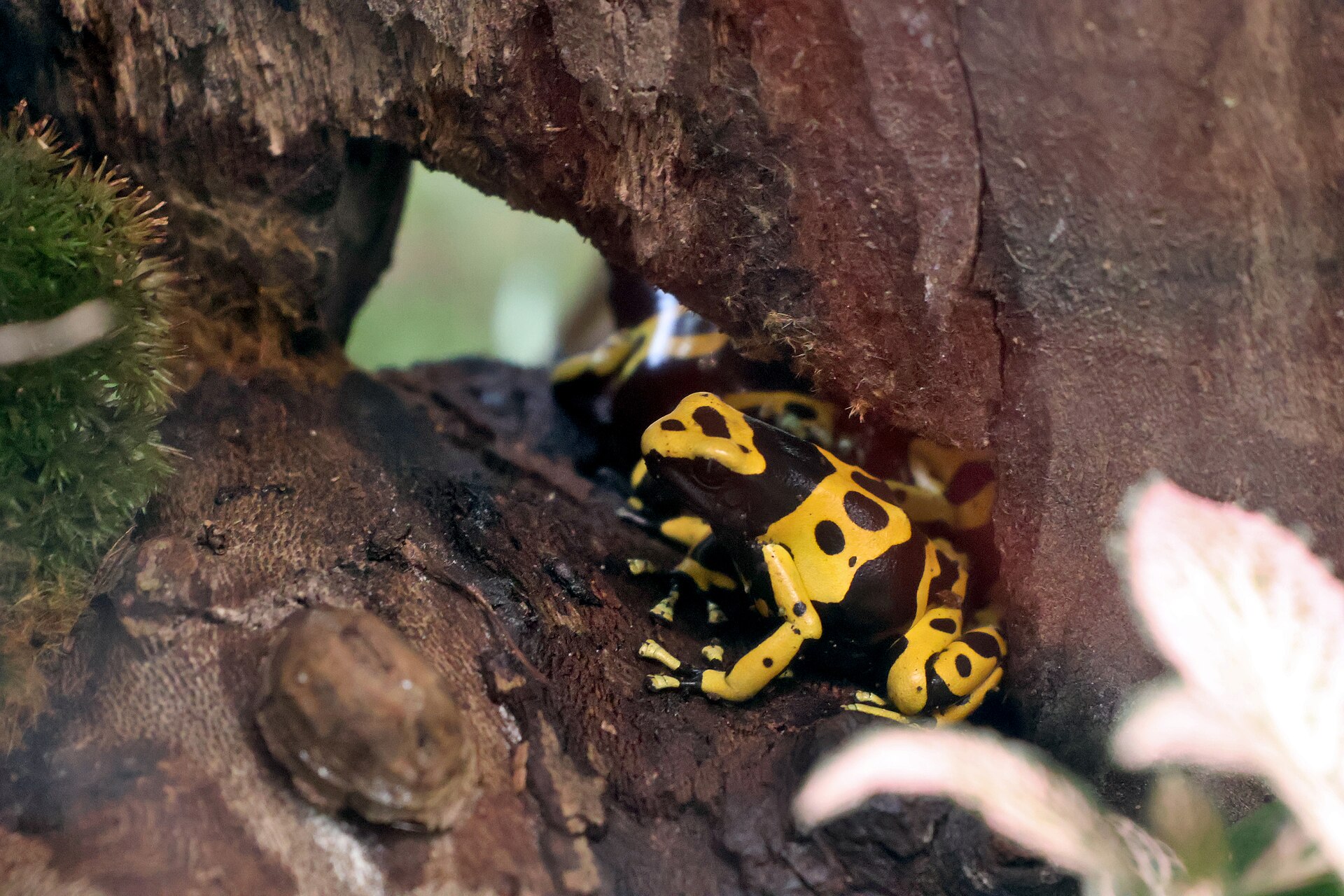
Yellow-Banded Dart Frog Care
Dendrobates leucomelas
The friendliest entry point into dart frogs — the 'bumblebee frog' tolerates minor husbandry lapses better than most dendrobatids and does well in small groups in a planted vivarium.
UVB Setup Calculator
Enter your enclosure dimensions — we'll recommend the right UVB bulb and mounting height for Yellow-Banded Dart Frog.
Yellow-Banded Dart Frog care specs
- Care level
- beginner (widely considered the most beginner-friendly dart frog; tolerates humidity fluctuations better than congeners)
- Adult size
- 1.2–1.6 in
- Lifespan (yrs)
- 10–15 average
- Daytime (°F)
- 72–82
- Night (°F)
- 65–74
- Humidity (%)
- 70–95
- UVB need
- low
- Setup
- terrestrial bioactive vivarium
- Diet type
- insectivore
- Diet
- insectivore
- Min vivarium
- 18×18×24 in for 3–4 frogs
- Housing
- Good for groups
- Price (USD)
- 50–80
- Origin
- Northern South America: southeastern Venezuela
Where to buy & shop for Yellow-Banded Dart Frog
Affiliate links — we may earn a small commission at no cost to you.
What is a Yellow-Banded Dart Frog?
A Yellow-Banded Dart Frog is a advanced-keeper frog from Northern South America: southeastern Venezuela. Adults reach 1.2–1.6 in (3.1–4.1 cm); females slightly larger than males and can live 10–15 average; records over 20 years in captivity years in captivity. The friendliest entry point into dart frogs — the 'bumblebee frog' tolerates minor husbandry lapses better than most dendrobatids and does well in small groups in a planted vivarium. Yellow-Banded Dart Frogs are an advanced-keeper species that demand precise, consistent husbandry.
What size vivarium does a Yellow-Banded Dart Frog need?
The minimum enclosure for an adult Yellow-Banded Dart Frog is 18×18×24 in for 3–4 frogs (or 18×18×18 minimum for a pair); wider footprint preferred; bioactive vivarium with drainage layer and live plants standard. A terrestrial bioactive vivarium with deep, moist substrate suits this species. Good drainage and ventilation are non-negotiable — stagnant wet substrate causes bacterial and fungal infections.
What you need:
- Terrestrial vivarium — 18×18×24 in for 3–4 frogs (or 18×18×18 minimum for a pair); wider footprint preferred; bioactive vivarium with drainage layer and live plants standard minimum; wider than tall.
- Deep substrate — 4–6 in of coconut fiber, peat-moss mix, or bioactive blend.
- Drainage layer — prevents waterlogging; isopods and springtails control bacteria.
- Cork bark and leaf litter — hides and cover; essential for security and humidity.
- Screen top with ventilation — airflow prevents respiratory infections and fungal growth.
What temperature does a Yellow-Banded Dart Frog need?
Amphibians require NO basking lamp. Yellow-Banded Dart Frogs are kept at ambient/room temperature — daytime 72–82°F, night drop to 65–74°F. Most frogs overheat rapidly above their maximum; if your home runs warm, a small fan or cooling rack is safer than any heat source. Use a reliable digital thermometer; stick-on strip gauges are inaccurate.
| Period | Temperature |
|---|---|
| Daytime | 72–82°F |
| Night | 65–74°F |
Do Yellow-Banded Dart Frogs need UVB?
UVB is low/optional for Yellow-Banded Dart Frogs — target UVI 0.5–1.0 (Ferguson Zone 1). A T5 HO low-output bulb (e.g., Arcadia ShadeDweller) benefits calcium metabolism and D3 synthesis without creating a basking hotspot. It is not strictly required if feeders are consistently dusted with calcium+D3, but low UVB supports long-term bone health. Provide a 12-hour photoperiod on a timer; replace bulbs every 12 months regardless of visible light output.
What humidity does a Yellow-Banded Dart Frog need?
Maintain humidity at 70–95% by misting with dechlorinated or spring water. Never use tap water directly — chlorine and chloramines penetrate the skin of amphibians and cause tissue damage. Mist thoroughly but allow the substrate surface to breathe between sessions; stagnant 100% humidity with no airflow causes bacterial and fungal infections. Good ventilation (screen top or cross-ventilation panels) is as important as the misting itself. A digital hygrometer is essential.
What do Yellow-Banded Dart Frogs eat?
Yellow-Banded Dart Frogs are insectivores requiring live micro-feeders — primarily fruit flies and springtails. MICRO feeders only — prey length must not exceed 3 mm (0.12 in). Staple: D. melanogaster and D. hydei fruit flies. Supplement with springtails, bean beetles, aphids, and small isopods. Adults: feed every 2–3 days. Juveniles: daily. Dust all feeders with calcium + D3 every feeding.
- Flightless fruit flies — D. melanogaster for froglets; D. hydei for larger adults.
- Springtails — in a bioactive vivarium; supplement feeders and aid cleanup.
- Isopods — vivarium cleanup crew; also consumed opportunistically.
- Prey size — must not exceed 3 mm (0.12 in); frogs can choke on oversized feeders.
- Dust every feeding — calcium+D3; multivitamin 1–2×/month.
- Gut-load feeders — 24–48 hr before offering for maximum nutrition.
Can you house Yellow-Banded Dart Frogs together?
Good for groups; recommend majority-male ratio (e.g., 2–3M : 1–2F) as females can be aggressive toward each other when competing for a specific male. Provide ample visual barriers. Can be kept in pairs or small groups with appropriate space. Amphibians have delicate, permeable skin that absorbs everything they contact — including oils, residues, and pathogens from human hands. Handle minimally. When handling is necessary (health checks, enclosure maintenance), use clean, wet, powder-free gloves or rinse hands thoroughly with dechlorinated water. Never handle after using lotions, soaps, or hand sanitizer.
Are Yellow-Banded Dart Frogs good for beginners?
Yellow-Banded Dart Frogs are an advanced species for experienced keepers. Research thoroughly, set up the vivarium completely before the animal arrives, and source only captive-bred specimens from a reputable breeder. Animals cost 50–80 (standard banded/nominant morphs); specialty locales (Fine Spot, Camo, Blue Foot) 100–500+.
What is a Yellow-Banded Dart Frog?
A Yellow-Banded Dart Frog is a advanced-keeper frog from Northern South America: southeastern Venezuela. Adults reach 1.2–1.6 in (3.1–4.1 cm); females slightly larger than males and live 10–15 average; records over 20 years in captivity years in captivity.
How big do Yellow-Banded Dart Frogs get?
1.2–1.6 in (3.1–4.1 cm); females slightly larger than males. Yellow-Banded Dart Frogs reach this size over a lifespan of 10–15 average; records over 20 years in captivity years — plan your enclosure for the adult size from the start.
What size vivarium does a Yellow-Banded Dart Frog need?
The minimum vivarium for an adult Yellow-Banded Dart Frog is 18×18×24 in for 3–4 frogs (or 18×18×18 minimum for a pair); wider footprint preferred; bioactive vivarium with drainage layer and live plants standard. Bigger is always better — provide the adult-size enclosure from day one rather than upgrading later.
What temperature does a Yellow-Banded Dart Frog need?
Yellow-Banded Dart Frogs need no basking lamp — maintain ambient daytime temperature of 72–82°F with a night drop to 65–74°F. Most frogs overheat rapidly above their maximum; monitor with a digital thermometer.
Do Yellow-Banded Dart Frogs need UVB?
UVB is low/optional for Yellow-Banded Dart Frogs (Ferguson Zone 1, UVI 0.5–1.0). Low UVB across the vivarium supports long-term bone health and D3 synthesis; it is optional if you supplement calcium+D3 consistently. No basking lamp is used — a low-output T5 HO bulb (e.g., Arcadia ShadeDweller) placed above the enclosure is ideal.
What do Yellow-Banded Dart Frogs eat?
MICRO feeders only — prey length must not exceed 3 mm (0.12 in). Staple: D. melanogaster and D. hydei fruit flies. Supplement with springtails, bean beetles, aphids, and small isopods. Adults: feed every 2–3 days. Juveniles: daily. Dust all feeders with calcium + D3 every feeding.
Can you house Yellow-Banded Dart Frogs together?
Good for groups; recommend majority-male ratio (e.g., 2–3M : 1–2F) as females can be aggressive toward each other when competing for a specific male. Provide ample visual barriers. Can be kept in pairs or small groups with appropriate space.
Are Yellow-Banded Dart Frogs good for beginners?
Advanced — Yellow-Banded Dart Frogs are not recommended for beginners. They require precise husbandry, are highly sensitive to temperature and humidity swings, and do not forgive mistakes.
How long do Yellow-Banded Dart Frogs live?
10–15 average; records over 20 years in captivity years in captivity with proper care. This is a significant long-term commitment — factor that in before purchasing.