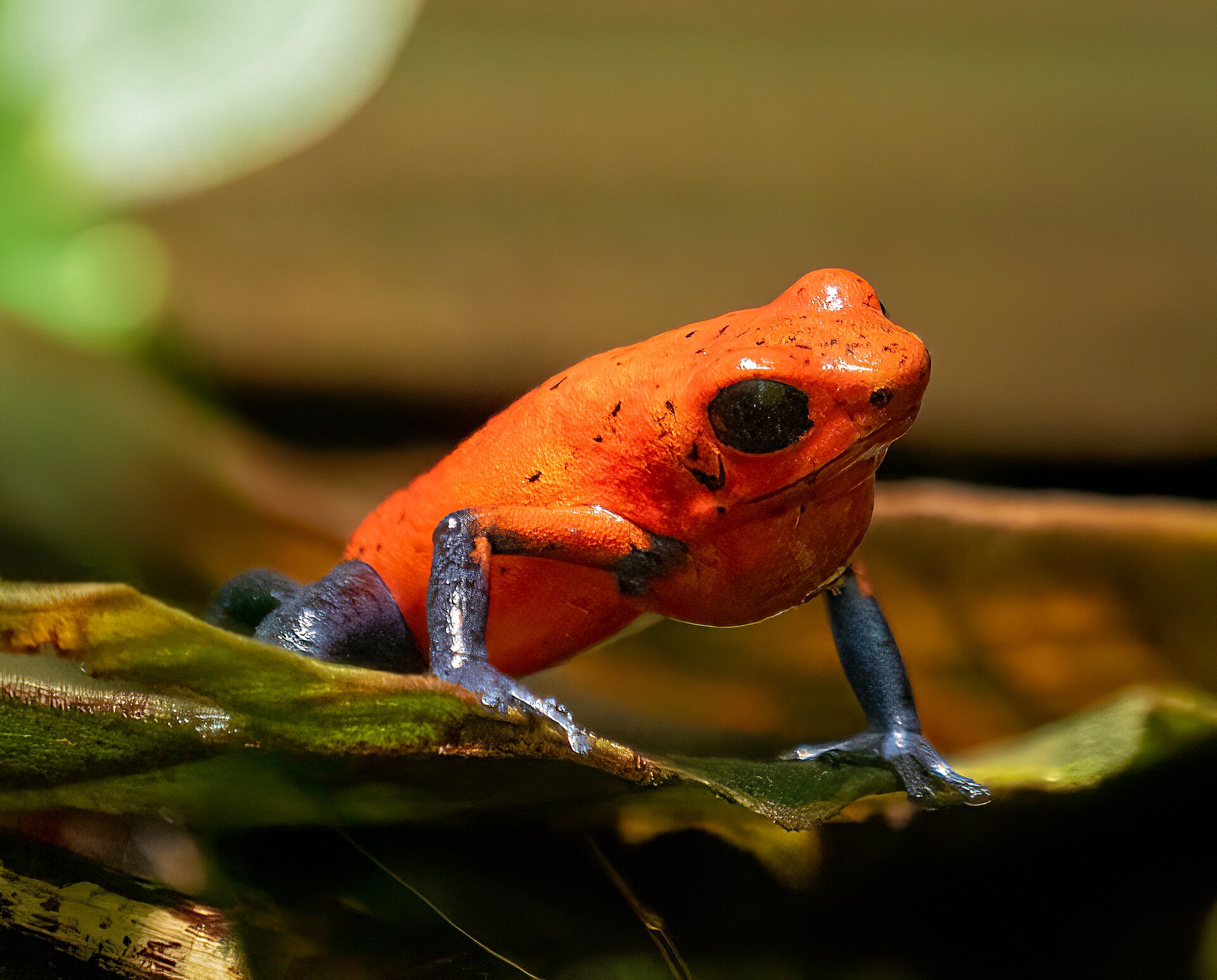
Strawberry Dart Frog Care
Oophaga pumilio
The iconic strawberry frog of Bocas del Toro — stunning locale-specific color diversity, fascinating parental-care behavior, but highly territorial and morph-mixing prohibited; best for keepers already experienced with dart frogs.
UVB Setup Calculator
Enter your enclosure dimensions — we'll recommend the right UVB bulb and mounting height for Strawberry Dart Frog.
Strawberry Dart Frog care specs
- Care level
- advanced (demanding parental-care breeding behavior; highly territorial; many color morphs — morph mixing strictly forbidden; suitable for experienced keepers)
- Adult size
- 0.75–1.0 in
- Lifespan (yrs)
- 8–12
- Daytime (°F)
- 72–80
- Night (°F)
- 68–72
- Humidity (%)
- 80–100
- UVB need
- low
- Setup
- terrestrial bioactive vivarium
- Diet type
- insectivore
- Diet
- insectivore
- Min vivarium
- 12×12×18 in for a pair or trio
- Housing
- ADVANCED cohabitation management required
- Price (USD)
- 80–150
- Origin
- Central America: Costa Rica, Panama, and adjacent islands
Where to buy & shop for Strawberry Dart Frog
Affiliate links — we may earn a small commission at no cost to you.
What is a Strawberry Dart Frog?
A Strawberry Dart Frog is a advanced-keeper frog from Central America: Costa Rica. Adults reach 0.75–1.0 in (1.9–2.5 cm); tiny — one of the smaller commonly kept dart frogs and can live 8–12 (some sources cite up to 12–15 under excellent care) years in captivity. The iconic strawberry frog of Bocas del Toro — stunning locale-specific color diversity, fascinating parental-care behavior, but highly territorial and morph-mixing prohibited; best for keepers already experienced with dart frogs. Strawberry Dart Frogs are an advanced-keeper species that demand precise, consistent husbandry.
What size vivarium does a Strawberry Dart Frog need?
The minimum enclosure for an adult Strawberry Dart Frog is 12×12×18 in for a pair or trio; 18×18×24 or larger for groups of 4+; bromeliads are essential — females deposit tadpoles into water-filled bromeliad axils; bioactive setup mandatory. This is an arboreal species — height is critical. Use a tall, well-ventilated planted vivarium with horizontal branches, cork bark hides, and broad-leaf plants for perching and daytime roosting.
What you need:
- Tall planted vivarium — 18×18×24 in minimum; height prioritised over footprint.
- Horizontal branches and cork bark — multiple perching levels; hides at various heights.
- Live or artificial foliage — broad-leaf plants for cover and humidity.
- Drainage layer — false bottom or drainage mesh + substrate barrier to prevent root rot.
- Ventilation panels — cross-ventilation prevents stagnant air and bacterial buildup.
What temperature does a Strawberry Dart Frog need?
Amphibians require NO basking lamp. Strawberry Dart Frogs are kept at ambient/room temperature — daytime 72–80°F, night drop to 68–72°F. Most frogs overheat rapidly above their maximum; if your home runs warm, a small fan or cooling rack is safer than any heat source. Use a reliable digital thermometer; stick-on strip gauges are inaccurate.
| Period | Temperature |
|---|---|
| Daytime | 72–80°F |
| Night | 68–72°F |
Do Strawberry Dart Frogs need UVB?
UVB is low/optional for Strawberry Dart Frogs — target UVI 0.5–1.0 (Ferguson Zone 1). A T5 HO low-output bulb (e.g., Arcadia ShadeDweller) benefits calcium metabolism and D3 synthesis without creating a basking hotspot. It is not strictly required if feeders are consistently dusted with calcium+D3, but low UVB supports long-term bone health. Provide a 12-hour photoperiod on a timer; replace bulbs every 12 months regardless of visible light output.
What humidity does a Strawberry Dart Frog need?
Maintain humidity at 80–100% by misting with dechlorinated or spring water. Never use tap water directly — chlorine and chloramines penetrate the skin of amphibians and cause tissue damage. Mist thoroughly but allow the substrate surface to breathe between sessions; stagnant 100% humidity with no airflow causes bacterial and fungal infections. Good ventilation (screen top or cross-ventilation panels) is as important as the misting itself. A digital hygrometer is essential.
What do Strawberry Dart Frogs eat?
Strawberry Dart Frogs are insectivores requiring live micro-feeders — primarily fruit flies and springtails. Micro-feeders only — D. melanogaster fruit flies are the primary staple throughout life (adults stay small). Springtails, bean beetles, and isopods supplement the diet. All prey must be tiny (no larger than frog's eye width). Dust with calcium + vitamin D3 supplement at every feeding. Feed small amounts daily.
- Flightless fruit flies — D. melanogaster for froglets; D. hydei for larger adults.
- Springtails — in a bioactive vivarium; supplement feeders and aid cleanup.
- Isopods — vivarium cleanup crew; also consumed opportunistically.
- Prey size — must not exceed 3 mm (0.12 in); frogs can choke on oversized feeders.
- Dust every feeding — calcium+D3; multivitamin 1–2×/month.
- Gut-load feeders — 24–48 hr before offering for maximum nutrition.
Can you house Strawberry Dart Frogs together?
ADVANCED cohabitation management required. Males are highly territorial and aggressive — fight, wrestle, and stress-call to establish territories. Females can be housed in pairs or trios with one male, but space and visual barriers are critical. Do NOT house multiple males together in small enclosures. NEVER mix morphs (hybridization produces unmarketable, ecologically problematic offspring). Amphibians have delicate, permeable skin that absorbs everything they contact — including oils, residues, and pathogens from human hands. Handle minimally. When handling is necessary (health checks, enclosure maintenance), use clean, wet, powder-free gloves or rinse hands thoroughly with dechlorinated water. Never handle after using lotions, soaps, or hand sanitizer.
Are Strawberry Dart Frogs good for beginners?
Strawberry Dart Frogs are an advanced species for experienced keepers. Research thoroughly, set up the vivarium completely before the animal arrives, and source only captive-bred specimens from a reputable breeder. Animals cost 80–150 (standard red/blue jeans morph); specialty morphs (Bastimentos, Almirante, Nicky, etc.) 120–250+.
What is a Strawberry Dart Frog?
A Strawberry Dart Frog is a advanced-keeper frog from Central America: Costa Rica. Adults reach 0.75–1.0 in (1.9–2.5 cm); tiny — one of the smaller commonly kept dart frogs and live 8–12 (some sources cite up to 12–15 under excellent care) years in captivity.
How big do Strawberry Dart Frogs get?
0.75–1.0 in (1.9–2.5 cm); tiny — one of the smaller commonly kept dart frogs. Strawberry Dart Frogs reach this size over a lifespan of 8–12 (some sources cite up to 12–15 under excellent care) years — plan your enclosure for the adult size from the start.
What size vivarium does a Strawberry Dart Frog need?
The minimum vivarium for an adult Strawberry Dart Frog is 12×12×18 in for a pair or trio; 18×18×24 or larger for groups of 4+; bromeliads are essential — females deposit tadpoles into water-filled bromeliad axils; bioactive setup mandatory. Bigger is always better — provide the adult-size enclosure from day one rather than upgrading later.
What temperature does a Strawberry Dart Frog need?
Strawberry Dart Frogs need no basking lamp — maintain ambient daytime temperature of 72–80°F with a night drop to 68–72°F. Most frogs overheat rapidly above their maximum; monitor with a digital thermometer.
Do Strawberry Dart Frogs need UVB?
UVB is low/optional for Strawberry Dart Frogs (Ferguson Zone 1, UVI 0.5–1.0). Low UVB across the vivarium supports long-term bone health and D3 synthesis; it is optional if you supplement calcium+D3 consistently. No basking lamp is used — a low-output T5 HO bulb (e.g., Arcadia ShadeDweller) placed above the enclosure is ideal.
What do Strawberry Dart Frogs eat?
Micro-feeders only — D. melanogaster fruit flies are the primary staple throughout life (adults stay small). Springtails, bean beetles, and isopods supplement the diet. All prey must be tiny (no larger than frog's eye width). Dust with calcium + vitamin D3 supplement at every feeding. Feed small amounts daily.
Can you house Strawberry Dart Frogs together?
ADVANCED cohabitation management required. Males are highly territorial and aggressive — fight, wrestle, and stress-call to establish territories. Females can be housed in pairs or trios with one male, but space and visual barriers are critical. Do NOT house multiple males together in small enclosures. NEVER mix morphs (hybridization produces unmarketable, ecologically problematic offspring).
Are Strawberry Dart Frogs good for beginners?
Advanced — Strawberry Dart Frogs are not recommended for beginners. They require precise husbandry, are highly sensitive to temperature and humidity swings, and do not forgive mistakes.
How long do Strawberry Dart Frogs live?
8–12 (some sources cite up to 12–15 under excellent care) years in captivity with proper care. This is a significant long-term commitment — factor that in before purchasing.