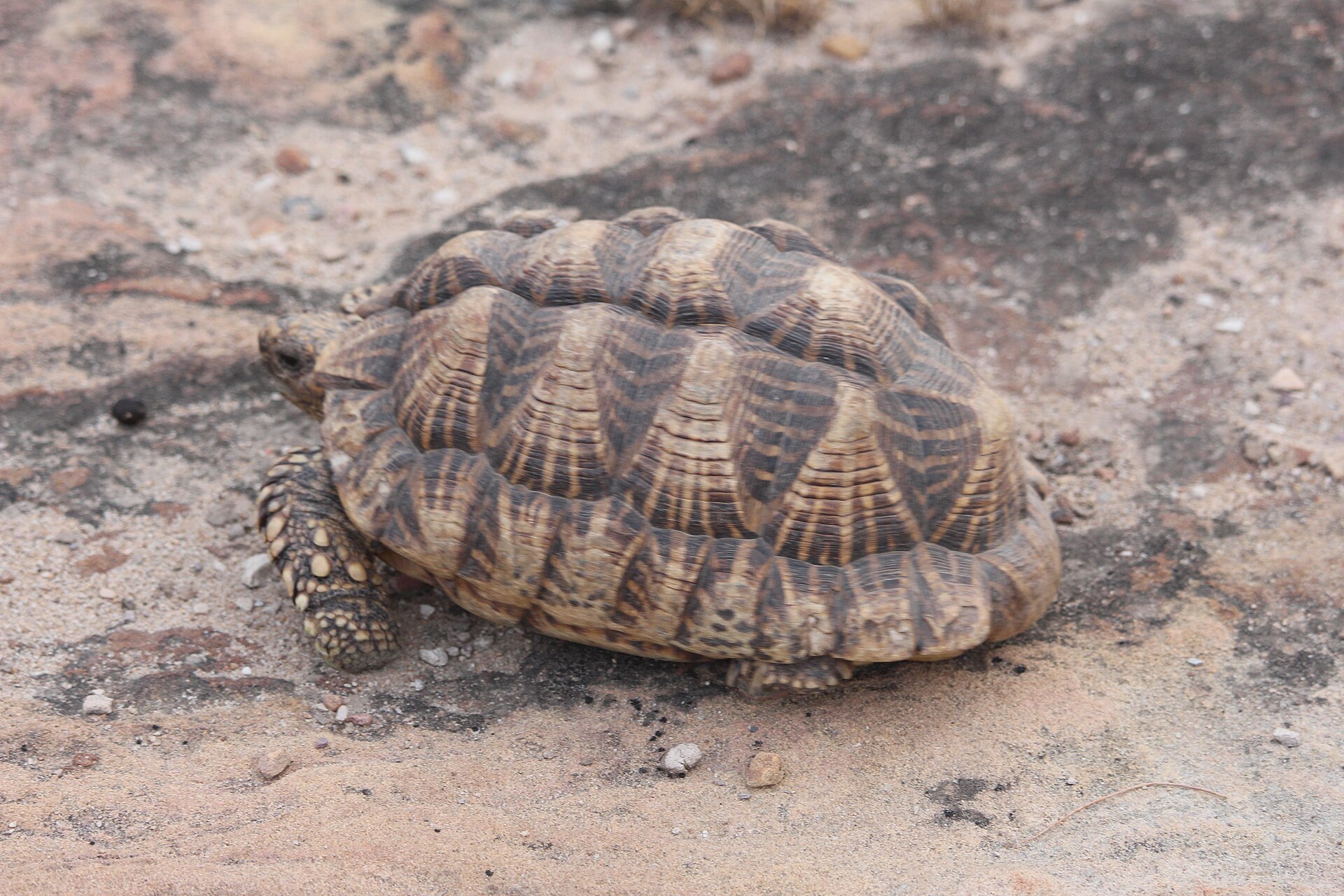
Star Tortoise Care
Geochelone elegans
One of the most visually striking tortoises, Indian stars are advanced-care animals — CITES Appendix I listed, humidity-sensitive, non-brumating, and intolerant of other tortoise species — rewarding only for keepers who can precisely replicate their intermediate-humidity, warm tropical environment.
UVB Setup Calculator
Enter your enclosure dimensions — we'll recommend the right UVB bulb and mounting height for Star Tortoise.
Star Tortoise care specs
- Care level
- advanced
- Adult size
- 6–12 in shell length
- Lifespan (yrs)
- 40–80
- Basking (°F)
- 95–105
- Cool side / water (°F)
- 77–82
- UVB need
- high
- Target UVI (Ferguson)
- 3.0–4.0
- Humidity (%)
- 50–75 adults
- Diet type
- herbivore
- Diet
- herbivore
- Min enclosure (adult)
- Indoor minimum: 16 sq ft
- Housing
- Possible with same species and similarly-sized individuals
- Price (USD)
- 400–700
- Origin
- Indian subcontinent
Where to buy & shop for Star Tortoise
Affiliate links — we may earn a small commission at no cost to you.
What is a Star Tortoise?
A Star Tortoise is a advanced-keeper tortoise from Indian subcontinent — dry and semi-arid thorn scrubland. Adults reach 6–12 in shell length (pronounced sexual dimorphism — males 6–8 in; females 8–12 in, occasionally larger); females up to 2.5–3 kg; males much smaller at 0.8–1.2 kg and can live 40–80 (captive care estimate; some sources cite up to 100 with exceptional husbandry) years in captivity — a long-term commitment. One of the most visually striking tortoises, Indian stars are advanced-care animals — CITES Appendix I listed, humidity-sensitive, non-brumating, and intolerant of other tortoise species — rewarding only for keepers who can precisely replicate their intermediate-humidity, warm tropical environment.
What size enclosure does a Star Tortoise need?
The minimum enclosure for an adult Star Tortoise is Indoor minimum: 16 sq ft (4×4 ft) for one adult female; minimum 5×2 ft or 6×3 ft per keeper consensus; larger is strongly preferred. Enclosure should be fully or semi-closed to maintain humidity gradient. Outdoor housing recommended as primary enclosure in climates with warm, humid summers (min night temp 68°F+); must be brought indoors below 70°F. Not suitable for full-time outdoor housing in temperate climates. Do NOT house with other tortoise species — high disease transmission risk.. Floor space is the priority for terrestrial tortoises. Adults typically need outdoor housing to meet roaming, thermoregulation, and grazing needs.
What you need:
- Outdoor enclosure (100+ sq ft) — adults need outdoor space; secure burrowing-proof walls.
- Warm shelter/hide — insulated box or heated indoor space for cool nights.
- Deep substrate — 6–12 in minimum for natural burrowing behaviour.
- Basking lamp + UVB — over the primary basking area; T5 HO 12% or 14% tube.
- Grazing area / browse — grasses, edible weeds; sunlight exposure is essential.
What temperature does a Star Tortoise need?
Provide a basking spot of 95–105°F and a cool side of 77–82°F. Measure surface temperature with an infrared thermometer. Use a high-wattage basking bulb on a dimmer or thermostat — never a heat rock. Drop to 70–75°F at night to support digestion and immune function.
| Zone | Temperature |
|---|---|
| Basking spot | 95–105°F (measure surface temperature with an infrared thermometer) |
| Cool side | 77–82°F |
| Night | 70–75°F |
Do Star Tortoises need UVB?
Yes — Star Tortoises need high UVB (target UVI 3.0–4.0). Use a T5 HO 12–14% tube (e.g., Arcadia Desert 12% or Zoo Med ReptiSun 10.0) mounted directly above the basking spot. Use the UVB Calculator above to confirm mounting height and basking platform height. Verify with a Solarmeter 6.5 and replace bulbs every 12 months.
What humidity does a Star Tortoise need?
Maintain humidity at 50–75 adults%. Moderate humidity suits most commonly available substrates. Maintain a moist hide in one corner to support proper shedding. A digital hygrometer is essential.
What do Star Tortoises eat?
Star Tortoises are strict herbivores — grasses, hay, and edible weeds form the bulk of the diet. Strict herbivore: high-fiber, low-protein, low-sugar diet primarily of grasses and weeds — ~50% grasses and hay (Bermuda, ryegrass, Timothy, orchard grass, alfalfa in moderation), ~40–50% tortoise-safe weeds and flowers (dandelion, clover, mallow, hibiscus, mulberry leaves, grape leaves, coriander, plantain). Dark leafy greens (collard, mustard, turnip greens, kale in moderation) supplement. Cactus pads (Opuntia) are excellent. Vegetables (carrot, squash, pumpkin) occasionally. AVOID: all fruit (avoid entirely or absolute minimum — this species is prone to gut dysbiosis from sugar), any animal protein whatsoever, spinach and other high-oxalate foods, avocado, rhubarb. Calcium dusting every feeding for juveniles; every other feeding for adults. Do NOT feed dog food, cat food, or commercial pellets not designed for tortoises. Never offer any animal protein, insects, or rodents — these cause serious organ damage in herbivorous species.
- Grasses and hay — the bulk of the diet (Bermuda, orchard, timothy grass, timothy hay).
- Edible weeds and wildflowers — dandelion, plantain, clover, mallow.
- Dark leafy greens — collard, mustard, turnip greens in moderation.
- No animal protein — never offer insects, rodents, or any meat; causes serious organ damage.
- Fresh water daily — in a wide, shallow dish changed every day.
Can you house Star Tortoises together?
Possible with same species and similarly-sized individuals; but NEVER house with other tortoise species (highly susceptible to picking up novel pathogens from other species). Males will mount and pursue females aggressively; give ample space or separate when not breeding. Juvenile and hatchling Indian stars are especially vulnerable — isolate from adults during early life. Allow new animals at least 2 weeks to settle in before handling. Support the body fully — avoid grabbing from above, which triggers a defensive response.
Are Star Tortoises good for beginners?
Star Tortoises are an advanced species for experienced keepers. Research thoroughly, set up the enclosure fully, and source from a reputable captive-bred breeder before acquiring. Animals cost 400–700 (captive-bred hatchlings, US market); well-started babies 500–800; juveniles and adults 600–1,200+. CITES Appendix I listed (2019) — wild-caught importation illegal; all legal specimens must be captive bred with documentation..
What is a Star Tortoise?
A Star Tortoise is a advanced-keeper tortoise from Indian subcontinent — dry and semi-arid thorn scrubland. Adults reach 6–12 in shell length (pronounced sexual dimorphism — males 6–8 in; females 8–12 in, occasionally larger); females up to 2.5–3 kg; males much smaller at 0.8–1.2 kg and live 40–80 (captive care estimate; some sources cite up to 100 with exceptional husbandry) years in captivity.
How big do Star Tortoises get?
6–12 in shell length (pronounced sexual dimorphism — males 6–8 in; females 8–12 in, occasionally larger); females up to 2.5–3 kg; males much smaller at 0.8–1.2 kg. Star Tortoises reach this size over a lifespan of 40–80 (captive care estimate; some sources cite up to 100 with exceptional husbandry) years — plan your enclosure for the adult size from the start.
What size enclosure does a Star Tortoise need?
The minimum enclosure for an adult Star Tortoise is Indoor minimum: 16 sq ft (4×4 ft) for one adult female; minimum 5×2 ft or 6×3 ft per keeper consensus; larger is strongly preferred. Enclosure should be fully or semi-closed to maintain humidity gradient. Outdoor housing recommended as primary enclosure in climates with warm, humid summers (min night temp 68°F+); must be brought indoors below 70°F. Not suitable for full-time outdoor housing in temperate climates. Do NOT house with other tortoise species — high disease transmission risk.. Bigger is always better — provide the adult-size enclosure from day one rather than upgrading later.
What temperature does a Star Tortoise need?
Basking spot 95–105°F, cool side 77–82°F — measure with a digital thermometer. Night temperatures can drop to 70–75°F. Always measure with a reliable digital thermometer.
Do Star Tortoises need UVB?
High UVB need. Star Tortoises need high UVB. Target UVI: 3.0–4.0. Use a T5 HO 12–14% tube and verify with a Solarmeter 6.5.
What do Star Tortoises eat?
Strict herbivore: high-fiber, low-protein, low-sugar diet primarily of grasses and weeds — ~50% grasses and hay (Bermuda, ryegrass, Timothy, orchard grass, alfalfa in moderation), ~40–50% tortoise-safe weeds and flowers (dandelion, clover, mallow, hibiscus, mulberry leaves, grape leaves, coriander, plantain). Dark leafy greens (collard, mustard, turnip greens, kale in moderation) supplement. Cactus pads (Opuntia) are excellent. Vegetables (carrot, squash, pumpkin) occasionally. AVOID: all fruit (avoid entirely or absolute minimum — this species is prone to gut dysbiosis from sugar), any animal protein whatsoever, spinach and other high-oxalate foods, avocado, rhubarb. Calcium dusting every feeding for juveniles; every other feeding for adults. Do NOT feed dog food, cat food, or commercial pellets not designed for tortoises.
Can you house Star Tortoises together?
Possible with same species and similarly-sized individuals; but NEVER house with other tortoise species (highly susceptible to picking up novel pathogens from other species). Males will mount and pursue females aggressively; give ample space or separate when not breeding. Juvenile and hatchling Indian stars are especially vulnerable — isolate from adults during early life.
Are Star Tortoises good for beginners?
Advanced — Star Tortoises are not recommended for beginners. They require precise husbandry, are stress-sensitive, and do not forgive mistakes.
How long do Star Tortoises live?
40–80 (captive care estimate; some sources cite up to 100 with exceptional husbandry) years in captivity with proper care. This is a significant long-term commitment — factor that in before purchasing.
Sources
- https://dubiaroaches.com/blogs/tortoise-care/indian-star-tortoise-care-sheet
- https://tortoiseresourcecenter.com/indian-star-tortoise-care/
- https://homeandroost.co.uk/blogs/tortoise/indian-star-tortoise
- https://www.reptilecentre.com/blogs/reptile-blog/which-ferguson-zone-is-my-reptile-in
- https://startortoises.net/caresheet.html