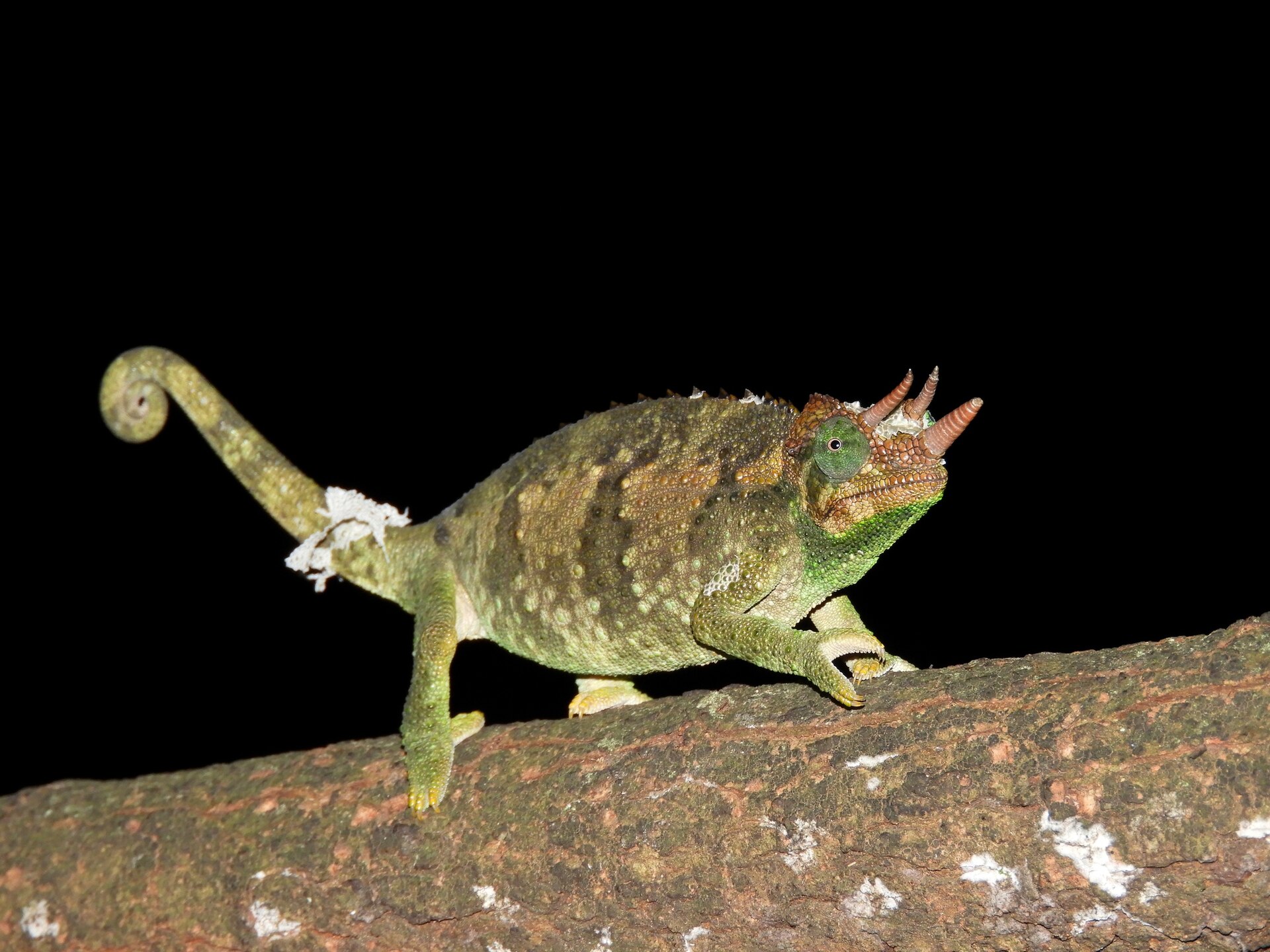
Jackson's Chameleon Care
Trioceros jacksonii
A three-horned montane chameleon from East African highlands that is viviparous (live-bearing) and requires cooler temperatures and significant nightly drops than most pet chameleons — demanding even by chameleon standards.
UVB Setup Calculator
Enter your enclosure dimensions — we'll recommend the right UVB bulb and mounting height for Jackson's Chameleon.
Jackson's Chameleon care specs
- Care level
- advanced
- Adult size
- 7–12 in
- Lifespan (yrs)
- 5–10
- Basking (°F)
- 82–85
- Cool side (°F)
- 68–75
- UVB need
- high
- Target UVI (Ferguson)
- 3.0
- Humidity (%)
- 50–80 daytime
- Diet type
- insectivore
- Diet
- insectivore
- Min enclosure (adult)
- 24×24×48 in tall
- Housing
- Strictly solitary
- Price (USD)
- 75–175
- Origin
- East African highlands: Mt
Where to buy & shop for Jackson's Chameleon
Affiliate links — we may earn a small commission at no cost to you.
What is a Jackson's Chameleon?
A Jackson's Chameleon is a advanced-keeper lizard from East African highlands: Mt. Kenya. Adults reach 7–12 in (females 7–9 in; males 8–12 in; subspecies vary: T.j. xantholophus largest at up to 13 in, T.j. merumontanus dwarf at 4–6 in) and can live 5–10 (males 8–10; females 3–6 in captivity; montane care and cool nights extend lifespan compared to overheated animals) years in captivity — a long-term commitment. A three-horned montane chameleon from East African highlands that is viviparous (live-bearing) and requires cooler temperatures and significant nightly drops than most pet chameleons — demanding even by chameleon standards.
What size enclosure does a Jackson's Chameleon need?
The minimum enclosure for an adult Jackson's Chameleon is 24×24×48 in tall (2×2×4 ft) screen/mesh enclosure minimum; height critical for arboreal species. Screen sides mandatory for ventilation — glass is fatal for Jackson's chameleons. Dense live or artificial planting provides thermoregulation gradient and psychological security. House males and females separately except during brief supervised breeding introductions.. Height is critical for this arboreal species — prioritise vertical space over floor footprint. A screen/mesh enclosure promotes the airflow this species needs to stay healthy.
What you need:
- Tall screen/mesh enclosure — height critical; prioritise vertical space over footprint.
- Live or artificial plants — for cover, perching, and humidity retention.
- Horizontal branches — multiple levels for basking and movement.
- Cross-ventilation — screen sides or cross-ventilation panels; stagnant humid air is fatal.
- Misting system — automated or manual, 2× daily minimum.
What temperature does a Jackson's Chameleon need?
Provide a basking spot of 82–85°F and a cool side of 68–75°F. Measure AIR temperature at the basking branch, not surface. Use a high-wattage basking bulb on a dimmer or thermostat — never a heat rock. Drop to 50–65°F at night to support digestion and immune function.
| Zone | Temperature |
|---|---|
| Basking spot | 82–85°F (measure AIR temperature at the basking branch, not surface) |
| Cool side | 68–75°F |
| Night | 50–65°F |
Do Jackson's Chameleons need UVB?
Yes — Jackson's Chameleons need high UVB (target UVI 3.0). Use a T5 HO 6% tube (e.g., Arcadia Forest 6% or Zoo Med 5.0) mounted on top of the screen, positioned approximately ⅔ of the cage height from the basking branch. Do NOT use a 12–14% tube for screen-housed arboreal species — at close basking distances through screen it over-doses UVB. Verify with a Solarmeter 6.5 and replace bulbs every 12 months.
What humidity does a Jackson's Chameleon need?
Maintain humidity at 50–80 daytime%. This species thrives on a wet/dry misting cycle — mist so all surfaces are wet, then allow the enclosure to dry fully before the next session. Good ventilation is non-negotiable; stagnant humid air causes fatal respiratory infections. A digital hygrometer is essential.
What do Jackson's Chameleons eat?
Jackson's Chameleons are insectivores — live or gut-loaded feeder insects are the diet staple. Live insects only: crickets, dubia roaches, hornworms, silkworms, black soldier fly larvae, waxworms (occasional). Adults: 3–8 richly gut-loaded insects every other day. Juveniles: feed daily, as much as they can eat. Feeder size: no wider than the space between the eyes. Gut-load feeders thoroughly. Supplement: calcium (no D3) at every other feeding; multivitamin 1–2× per month. D3 supplement only if UVB is insufficient.
- Staple feeders — dubia roaches, crickets, or mealworms as the main protein source.
- Variety feeders — superworms, hornworms, black soldier fly larvae for enrichment.
- Gut-load first — feed insects a nutritious diet 24–48 hr before offering to your Jackson's Chameleon.
- Calcium dusting — dust every feeding; use D3-containing supplement on a schedule matched to UVB.
- Fresh water — shallow dish changed daily; use a sponge or bottle cap to prevent drowning small feeders.
Can you house Jackson's Chameleons together?
Strictly solitary — house individually. Highly territorial; visual contact with conspecifics causes chronic stress. Males will fight fatally. Unlike veiled chameleons, Jackson's are viviparous (live-bearing) — females can store sperm and produce multiple litters from a single mating. Allow new animals at least 2 weeks to settle in before handling. Support the body fully — avoid grabbing from above, which triggers a defensive response.
Are Jackson's Chameleons good for beginners?
Jackson's Chameleons are an advanced species for experienced keepers. Research thoroughly, set up the enclosure fully, and source from a reputable captive-bred breeder before acquiring. Animals cost 75–175 (T.j. xantholophus most commonly available; wild-caught Hawaiian-origin animals often available but captive-bred preferred; rare Kenyan imports more expensive).
What is a Jackson's Chameleon?
A Jackson's Chameleon is a advanced-keeper lizard from East African highlands: Mt. Kenya. Adults reach 7–12 in (females 7–9 in; males 8–12 in; subspecies vary: T.j. xantholophus largest at up to 13 in, T.j. merumontanus dwarf at 4–6 in) and live 5–10 (males 8–10; females 3–6 in captivity; montane care and cool nights extend lifespan compared to overheated animals) years in captivity.
How big do Jackson's Chameleons get?
7–12 in (females 7–9 in; males 8–12 in; subspecies vary: T.j. xantholophus largest at up to 13 in, T.j. merumontanus dwarf at 4–6 in). Jackson's Chameleons reach this size over a lifespan of 5–10 (males 8–10; females 3–6 in captivity; montane care and cool nights extend lifespan compared to overheated animals) years — plan your enclosure for the adult size from the start.
What size enclosure does a Jackson's Chameleon need?
The minimum enclosure for an adult Jackson's Chameleon is 24×24×48 in tall (2×2×4 ft) screen/mesh enclosure minimum; height critical for arboreal species. Screen sides mandatory for ventilation — glass is fatal for Jackson's chameleons. Dense live or artificial planting provides thermoregulation gradient and psychological security. House males and females separately except during brief supervised breeding introductions.. Bigger is always better — provide the adult-size enclosure from day one rather than upgrading later.
What temperature does a Jackson's Chameleon need?
Basking spot 82–85°F, cool side 68–75°F — measure with a digital thermometer. Night temperatures can drop to 50–65°F. Always measure with a reliable digital thermometer.
Do Jackson's Chameleons need UVB?
High UVB need. Jackson's Chameleons need high UVB. Target UVI: 3.0 at the basking branch. Use a T5 HO 6% tube (e.g., Arcadia Forest 6%) on top of the screen — NOT a 12–14% tube, which over-doses UVB at close range through screen. Verify with a Solarmeter 6.5.
What do Jackson's Chameleons eat?
Live insects only: crickets, dubia roaches, hornworms, silkworms, black soldier fly larvae, waxworms (occasional). Adults: 3–8 richly gut-loaded insects every other day. Juveniles: feed daily, as much as they can eat. Feeder size: no wider than the space between the eyes. Gut-load feeders thoroughly. Supplement: calcium (no D3) at every other feeding; multivitamin 1–2× per month. D3 supplement only if UVB is insufficient.
Can you house Jackson's Chameleons together?
Strictly solitary — house individually. Highly territorial; visual contact with conspecifics causes chronic stress. Males will fight fatally. Unlike veiled chameleons, Jackson's are viviparous (live-bearing) — females can store sperm and produce multiple litters from a single mating.
Are Jackson's Chameleons good for beginners?
Advanced — Jackson's Chameleons are not recommended for beginners. They require precise husbandry, are stress-sensitive, and do not forgive mistakes.
How long do Jackson's Chameleons live?
5–10 (males 8–10; females 3–6 in captivity; montane care and cool nights extend lifespan compared to overheated animals) years in captivity with proper care. This is a significant long-term commitment — factor that in before purchasing.
Sources
- https://chameleonacademy.com/jacksons-chameleon-care/
- https://dubiaroaches.com/blogs/chameleon-care/jackson-s-chameleon-care-sheet
- https://reptilesmagazine.com/jacksons-chameleon-care-sheet/
- https://www.reptiles.swelluk.com/help-guides/how-to-care-for-a-jacksons-chameleon/
- https://www.reptilecentre.com/blogs/reptile-blog/which-ferguson-zone-is-my-reptile-in