Hermann's Tortoise Care
Testudo hermanni
One of the best beginner tortoises — Hermann's are compact, personable, and tolerant of moderate temperature variation, requiring a grass-and-weed herbivore diet with strong UVB and the option to brumate safely during winter.
UVB Setup Calculator
Enter your enclosure dimensions — we'll recommend the right UVB bulb and mounting height for Hermann's Tortoise.
Hermann's Tortoise care specs
- Care level
- beginner
- Adult size
- 5–8 in shell length
- Lifespan (yrs)
- 50–75+
- Basking (°F)
- 95–100
- Cool side / water (°F)
- 75–85
- UVB need
- high
- Target UVI (Ferguson)
- 3.0–4.0
- Humidity (%)
- 40–60 adults
- Diet type
- herbivore
- Diet
- herbivore
- Min enclosure (adult)
- Indoor minimum: 6×3 ft
- Housing
- Generally manageable if raised together
- Price (USD)
- 150–350
- Origin
- Mediterranean Europe
Where to buy & shop for Hermann's Tortoise
Affiliate links — we may earn a small commission at no cost to you.
What is a Hermann's Tortoise?
A Hermann's Tortoise is a beginner-friendly tortoise from Mediterranean Europe — southern France. Adults reach 5–8 in shell length (western subspecies T. h. hermanni smaller: males 4–6 in, females 5–7 in; eastern subspecies T. h. boettgeri larger: males 5–7 in, females 6–9 in); 1.5–4 lb and can live 50–75+ years in captivity — a long-term commitment. One of the best beginner tortoises — Hermann's are compact, personable, and tolerant of moderate temperature variation, requiring a grass-and-weed herbivore diet with strong UVB and the option to brumate safely during winter.
What size enclosure does a Hermann's Tortoise need?
The minimum enclosure for an adult Hermann's Tortoise is Indoor minimum: 6×3 ft (18 sq ft) for one adult, 8-in+ walls; 36+ sq ft strongly preferred. Outdoor pen (preferred in temperate climates with warm summers): minimum 6×4 ft per tortoise with secure buried perimeter, shelter/hide, and access to direct sunlight. Outdoor grazing on diverse, chemical-free plant material is ideal.. Floor space is the priority for terrestrial tortoises. Adults typically need outdoor housing to meet roaming, thermoregulation, and grazing needs.
What you need:
- Outdoor enclosure (100+ sq ft) — adults need outdoor space; secure burrowing-proof walls.
- Warm shelter/hide — insulated box or heated indoor space for cool nights.
- Deep substrate — 6–12 in minimum for natural burrowing behaviour.
- Basking lamp + UVB — over the primary basking area; T5 HO 12% or 14% tube.
- Grazing area / browse — grasses, edible weeds; sunlight exposure is essential.
What temperature does a Hermann's Tortoise need?
Provide a basking spot of 95–100°F and a cool side of 75–85°F. Measure surface temperature with an infrared thermometer. Use a high-wattage basking bulb on a dimmer or thermostat — never a heat rock. Drop to 65–72°F at night to support digestion and immune function.
| Zone | Temperature |
|---|---|
| Basking spot | 95–100°F (measure surface temperature with an infrared thermometer) |
| Cool side | 75–85°F |
| Night | 65–72°F |
Do Hermann's Tortoises need UVB?
Yes — Hermann's Tortoises need high UVB (target UVI 3.0–4.0). Use a T5 HO 12–14% tube (e.g., Arcadia Desert 12% or Zoo Med ReptiSun 10.0) mounted directly above the basking spot. Use the UVB Calculator above to confirm mounting height and basking platform height. Verify with a Solarmeter 6.5 and replace bulbs every 12 months.
What humidity does a Hermann's Tortoise need?
Maintain humidity at 40–60 adults%. Moderate humidity suits most commonly available substrates. Maintain a moist hide in one corner to support proper shedding. A digital hygrometer is essential.
What do Hermann's Tortoises eat?
Hermann's Tortoises are strict herbivores — grasses, hay, and edible weeds form the bulk of the diet. High-fiber, low-protein, low-sugar herbivore diet: broad-leaf weeds and grasses are the staple — dandelion (leaves, stems, flowers), plantain, mallow, clover, hibiscus flowers and leaves, mulberry leaves, orchard grass, timothy hay. Dark leafy greens (collard, mustard, turnip greens) as supplement. Cactus pads acceptable. Fruit as very rare treat only (small berry or melon, max 1×/week or less — excess sugar disrupts digestion). AVOID: any animal protein (insects, meat, eggs — Hermann's are strict herbivores), spinach and other high-oxalate foods, bread, dairy. Calcium supplementation (cuttlebone or dusting) essential. Never offer any animal protein, insects, or rodents — these cause serious organ damage in herbivorous species.
- Grasses and hay — the bulk of the diet (Bermuda, orchard, timothy grass, timothy hay).
- Edible weeds and wildflowers — dandelion, plantain, clover, mallow.
- Dark leafy greens — collard, mustard, turnip greens in moderation.
- No animal protein — never offer insects, rodents, or any meat; causes serious organ damage.
- Fresh water daily — in a wide, shallow dish changed every day.
Can you house Hermann's Tortoises together?
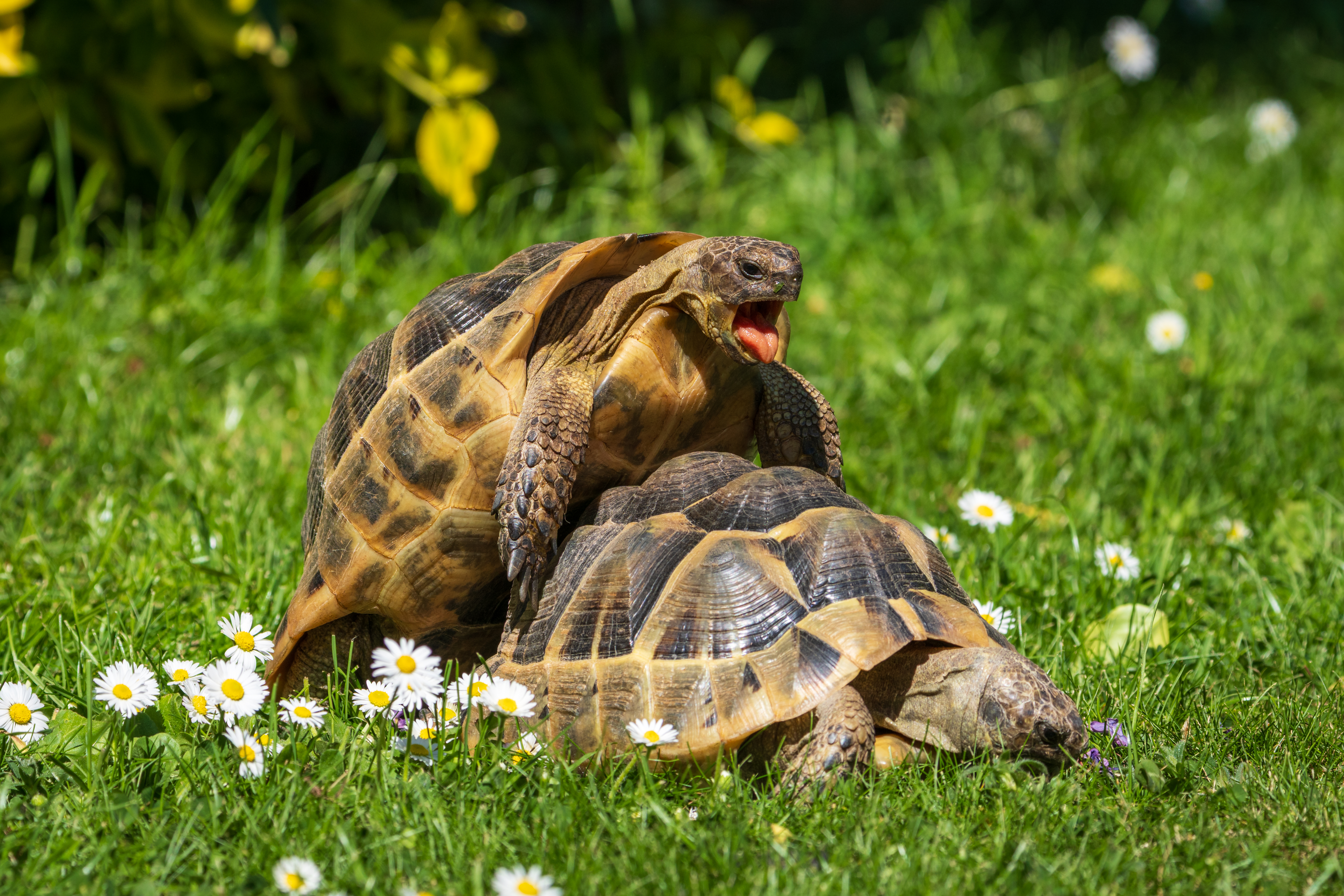
Generally manageable if raised together; males are territorial and will ram and mount one another, causing stress and injury in confined spaces. Males housed together require substantially enlarged space and close monitoring. Mixed-sex pairs are safest; a too-small enclosure risks female exhaustion from persistent male attention. Singly or same-sex groups with ample space is the conservative recommendation. Start with brief, calm handling sessions (5–10 minutes) and gradually increase as your Hermann's Tortoise becomes accustomed to you. Wash hands before and after every handling session.
Are Hermann's Tortoises good for beginners?
Yes — Hermann's Tortoises are an excellent first reptile. Animals cost 150–350 (captive-bred eastern Hermann's hatchlings, most common in US); western Hermann's (T. h. hermanni, EU origin) 200–500+ due to smaller supply; adults 300–600 depending on morph/locality. The main ongoing costs are fresh greens, grasses/hay, calcium supplementation, UVB bulb replacements, and occasional vet visits.
What is a Hermann's Tortoise?
A Hermann's Tortoise is a beginner-friendly tortoise from Mediterranean Europe — southern France. Adults reach 5–8 in shell length (western subspecies T. h. hermanni smaller: males 4–6 in, females 5–7 in; eastern subspecies T. h. boettgeri larger: males 5–7 in, females 6–9 in); 1.5–4 lb and live 50–75+ years in captivity.
How big do Hermann's Tortoises get?
5–8 in shell length (western subspecies T. h. hermanni smaller: males 4–6 in, females 5–7 in; eastern subspecies T. h. boettgeri larger: males 5–7 in, females 6–9 in); 1.5–4 lb. Hermann's Tortoises reach this size over a lifespan of 50–75+ years — plan your enclosure for the adult size from the start.
What size enclosure does a Hermann's Tortoise need?
The minimum enclosure for an adult Hermann's Tortoise is Indoor minimum: 6×3 ft (18 sq ft) for one adult, 8-in+ walls; 36+ sq ft strongly preferred. Outdoor pen (preferred in temperate climates with warm summers): minimum 6×4 ft per tortoise with secure buried perimeter, shelter/hide, and access to direct sunlight. Outdoor grazing on diverse, chemical-free plant material is ideal.. Bigger is always better — provide the adult-size enclosure from day one rather than upgrading later.
What temperature does a Hermann's Tortoise need?
Basking spot 95–100°F, cool side 75–85°F — measure with a digital thermometer. Night temperatures can drop to 65–72°F. Always measure with a reliable digital thermometer.
Do Hermann's Tortoises need UVB?
High UVB need. Hermann's Tortoises need high UVB. Target UVI: 3.0–4.0. Use a T5 HO 12–14% tube and verify with a Solarmeter 6.5.
What do Hermann's Tortoises eat?
High-fiber, low-protein, low-sugar herbivore diet: broad-leaf weeds and grasses are the staple — dandelion (leaves, stems, flowers), plantain, mallow, clover, hibiscus flowers and leaves, mulberry leaves, orchard grass, timothy hay. Dark leafy greens (collard, mustard, turnip greens) as supplement. Cactus pads acceptable. Fruit as very rare treat only (small berry or melon, max 1×/week or less — excess sugar disrupts digestion). AVOID: any animal protein (insects, meat, eggs — Hermann's are strict herbivores), spinach and other high-oxalate foods, bread, dairy. Calcium supplementation (cuttlebone or dusting) essential.
Can you house Hermann's Tortoises together?
Generally manageable if raised together; males are territorial and will ram and mount one another, causing stress and injury in confined spaces. Males housed together require substantially enlarged space and close monitoring. Mixed-sex pairs are safest; a too-small enclosure risks female exhaustion from persistent male attention. Singly or same-sex groups with ample space is the conservative recommendation.
Are Hermann's Tortoises good for beginners?
Yes — Hermann's Tortoises are among the best reptiles for first-time keepers. They are forgiving, handleable, and readily available captive-bred.
How long do Hermann's Tortoises live?
50–75+ years in captivity with proper care. This is a significant long-term commitment — factor that in before purchasing.
Sources
- https://thetortoisespot.com/care-guides/hermanns-tortoise/
- https://dubiaroaches.com/blogs/tortoise-care/hermann-s-tortoise-care-sheet
- https://www.reptilecentre.com/blogs/reptile-blog/which-ferguson-zone-is-my-reptile-in
- https://www.happytortoises.com/hermann-tortoise-care-sheet
- https://tortstork.com/?product=eastern-hermanns-hatchling