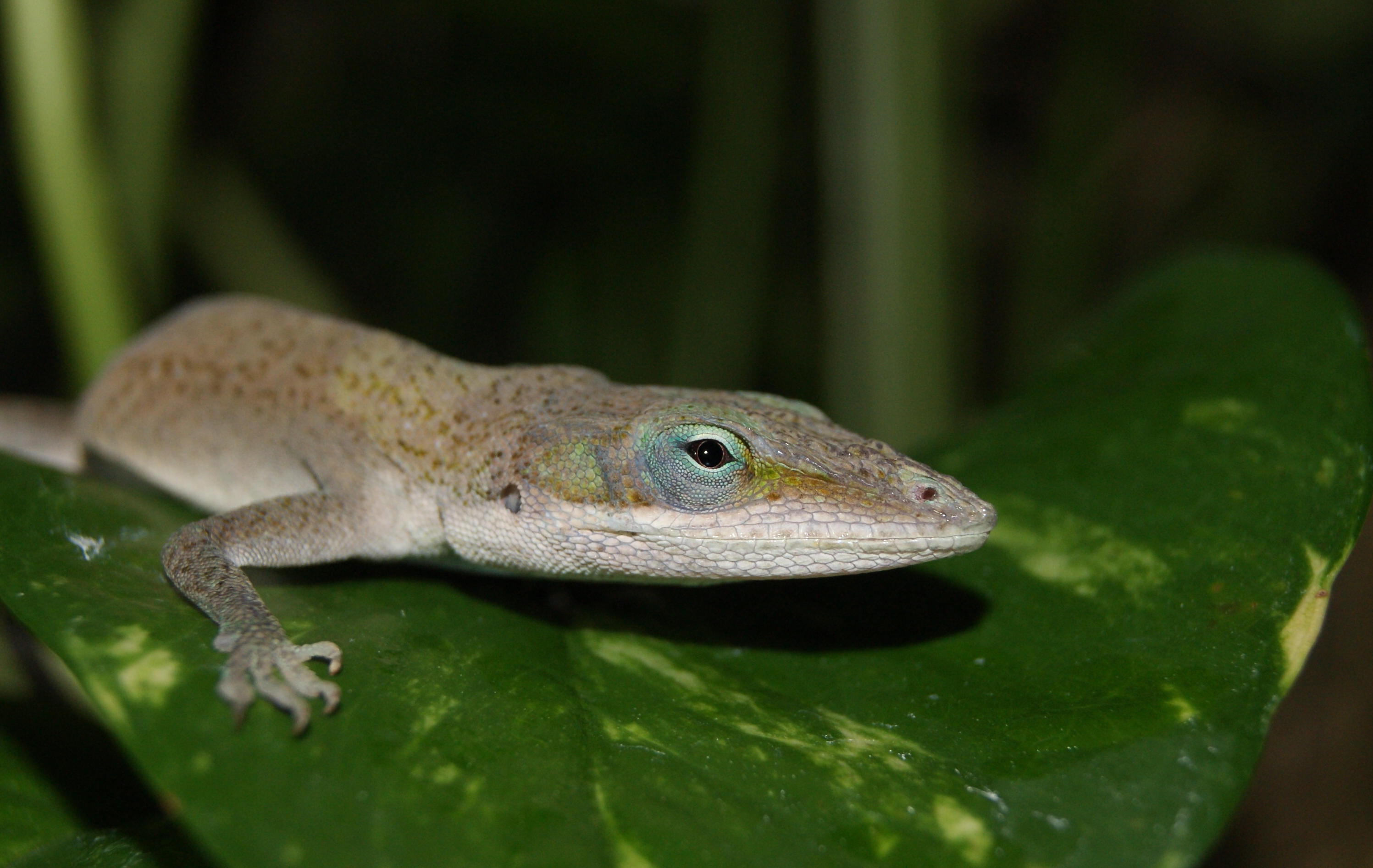
Green Anole Care
Anolis carolinensis
A small, agile, color-changing arboreal lizard native to the southeastern US that requires moderate UVB, a vertical planted enclosure, and high humidity — deceptively intermediate despite being cheap and common in pet stores.
UVB Setup Calculator
Enter your enclosure dimensions — we'll recommend the right UVB bulb and mounting height for Green Anole.
Green Anole care specs
- Care level
- intermediate
- Adult size
- 5–8 in total length
- Lifespan (yrs)
- 3–7
- Basking (°F)
- 85–90
- Cool side (°F)
- 70–75
- UVB need
- moderate
- Target UVI (Ferguson)
- 2.0–3.0
- Humidity (%)
- 60–70 average
- Diet type
- insectivore
- Diet
- insectivore
- Min enclosure (adult)
- Minimum 18×18×24 in
- Housing
- Males strictly solitary
- Price (USD)
- 5–15
- Origin
- Southeastern United States
Where to buy & shop for Green Anole
Affiliate links — we may earn a small commission at no cost to you.
What is a Green Anole?
A Green Anole is a intermediate-level lizard from Southeastern United States. Adults reach 5–8 in total length (males 6–8 in including tail; females 5–6 in; tail is ~60% of total length) and can live 3–7 (captive; some reach 8 years with excellent care; wild-caught animals from pet stores frequently arrive parasite-loaded and rarely reach 3 years — captive-bred animals are strongly preferred) years in captivity — a long-term commitment. A small, agile, color-changing arboreal lizard native to the southeastern US that requires moderate UVB, a vertical planted enclosure, and high humidity — deceptively intermediate despite being cheap and common in pet stores.
What size enclosure does a Green Anole need?
The minimum enclosure for an adult Green Anole is Minimum 18×18×24 in; 24×24×36 in (taller) preferred for a single adult. Height is critical for this arboreal species — prioritise vertical space over floor footprint. A screen/mesh enclosure promotes the airflow this species needs to stay healthy.
What you need:
- Tall screen/mesh enclosure — height critical; prioritise vertical space over footprint.
- Live or artificial plants — for cover, perching, and humidity retention.
- Horizontal branches — multiple levels for basking and movement.
- Cross-ventilation — screen sides or cross-ventilation panels; stagnant humid air is fatal.
- Misting system — automated or manual, 2× daily minimum.
What temperature does a Green Anole need?
Provide a basking spot of 85–90°F and a cool side of 70–75°F. Measure AIR temperature at the basking branch, not surface. Use a high-wattage basking bulb on a dimmer or thermostat — never a heat rock. Drop to 65–72°F at night to support digestion and immune function.
| Zone | Temperature |
|---|---|
| Basking spot | 85–90°F (measure AIR temperature at the basking branch, not surface) |
| Cool side | 70–75°F |
| Night | 65–72°F |
Do Green Anoles need UVB?
Green Anoles need moderate UVB — target UVI 2.0–3.0. Use a T5 HO 6% or 12% tube mounted at the correct distance above the basking spot. Use the UVB Calculator above — it accounts for enclosure height and basking platform height. Replace bulbs every 12 months.
What humidity does a Green Anole need?
Maintain humidity at 60–70 average%. This species thrives on a wet/dry misting cycle — mist so all surfaces are wet, then allow the enclosure to dry fully before the next session. Good ventilation is non-negotiable; stagnant humid air causes fatal respiratory infections. A digital hygrometer is essential.
What do Green Anoles eat?
Green Anoles are insectivores — live or gut-loaded feeder insects are the diet staple. Small live insects only: small crickets, fruit flies (Drosophila, for small animals), small mealworms, waxworms, small dubia roaches, black soldier fly larvae. Prey size critical: no insect larger than half the width of the anole's head (small mouth). Adults: 2–3 insects every other day. Juveniles: small insects daily. Supplement: calcium (without D3) every other feeding; calcium + D3 multivitamin once weekly. Gut-load all feeders.
- Staple feeders — dubia roaches, crickets, or mealworms as the main protein source.
- Variety feeders — superworms, hornworms, black soldier fly larvae for enrichment.
- Gut-load first — feed insects a nutritious diet 24–48 hr before offering to your Green Anole.
- Calcium dusting — dust every feeding; use D3-containing supplement on a schedule matched to UVB.
- Fresh water — shallow dish changed daily; use a sponge or bottle cap to prevent drowning small feeders.
Can you house Green Anoles together?
Males strictly solitary — two males will fight, display continuously, and the subordinate will die of stress. One male may be kept with 1–2 females in an adequately-sized planted enclosure. Female-only groups are generally peaceful in spacious setups. Watch for bullying even in female groups. Allow new animals at least 2 weeks to settle in before handling. Support the body fully — avoid grabbing from above, which triggers a defensive response.
Are Green Anoles good for beginners?
Green Anoles are intermediate-level — not ideal for complete beginners. Suitable for keepers who have successfully maintained a beginner reptile for at least a year. Animals typically cost 5–15 (wild-caught animals commonly sold at chain pet stores; captive-bred animals from specialty breeders or reptile expos 15–30; wild-caught animals not recommended due to high parasite load and poor establishment rate). Budget for quality enclosure hardware — this species will show you quickly if something is wrong.
What is a Green Anole?
A Green Anole is a intermediate-level lizard from Southeastern United States. Adults reach 5–8 in total length (males 6–8 in including tail; females 5–6 in; tail is ~60% of total length) and live 3–7 (captive; some reach 8 years with excellent care; wild-caught animals from pet stores frequently arrive parasite-loaded and rarely reach 3 years — captive-bred animals are strongly preferred) years in captivity.
How big do Green Anoles get?
5–8 in total length (males 6–8 in including tail; females 5–6 in; tail is ~60% of total length). Green Anoles reach this size over a lifespan of 3–7 (captive; some reach 8 years with excellent care; wild-caught animals from pet stores frequently arrive parasite-loaded and rarely reach 3 years — captive-bred animals are strongly preferred) years — plan your enclosure for the adult size from the start.
What size enclosure does a Green Anole need?
The minimum enclosure for an adult Green Anole is Minimum 18×18×24 in; 24×24×36 in (taller) preferred for a single adult. Bigger is always better — provide the adult-size enclosure from day one rather than upgrading later.
What temperature does a Green Anole need?
Basking spot 85–90°F, cool side 70–75°F — measure with a digital thermometer. Night temperatures can drop to 65–72°F. Always measure with a reliable digital thermometer.
Do Green Anoles need UVB?
Moderate UVB need. Green Anoles need a moderate-output UVB tube. Target UVI: 2.0–3.0 at the basking spot. Use the UVB Calculator on this page to find the right setup.
What do Green Anoles eat?
Small live insects only: small crickets, fruit flies (Drosophila, for small animals), small mealworms, waxworms, small dubia roaches, black soldier fly larvae. Prey size critical: no insect larger than half the width of the anole's head (small mouth). Adults: 2–3 insects every other day. Juveniles: small insects daily. Supplement: calcium (without D3) every other feeding; calcium + D3 multivitamin once weekly. Gut-load all feeders.
Can you house Green Anoles together?
Males strictly solitary — two males will fight, display continuously, and the subordinate will die of stress. One male may be kept with 1–2 females in an adequately-sized planted enclosure. Female-only groups are generally peaceful in spacious setups. Watch for bullying even in female groups.
Are Green Anoles good for beginners?
Intermediate — Green Anoles need a keeper who has already successfully maintained a simpler reptile. Not ideal as a first reptile.
How long do Green Anoles live?
3–7 (captive; some reach 8 years with excellent care; wild-caught animals from pet stores frequently arrive parasite-loaded and rarely reach 3 years — captive-bred animals are strongly preferred) years in captivity with proper care. This is a significant long-term commitment — factor that in before purchasing.