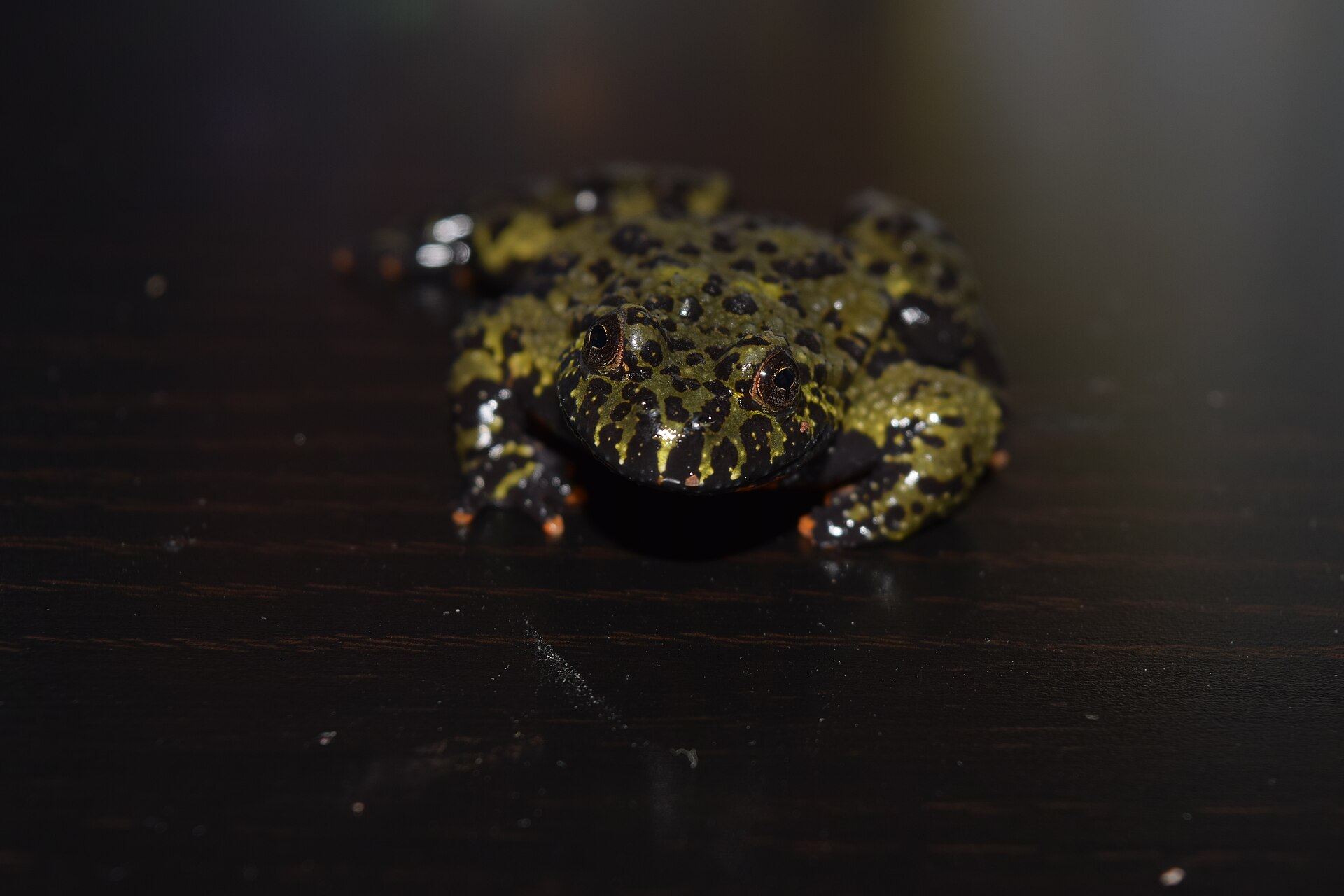
Fire-Bellied Toad Care
Bombina orientalis
A hardy, colorful semi-aquatic toad from temperate East Asia that thrives at room temperature in a land-and-water paludarium, makes an excellent communal display animal in groups, and requires no special heating — its glowing orange belly is a warning signal for mild toxins, so keep it species-only and wash hands after contact.
UVB Setup Calculator
Enter your enclosure dimensions — we'll recommend the right UVB bulb and mounting height for Fire-Bellied Toad.
Fire-Bellied Toad care specs
- Care level
- beginner
- Adult size
- 1.5–2 in
- Lifespan (yrs)
- 10–15
- Daytime (°F)
- 65–75 ambient
- Night (°F)
- 60–68
- Humidity (%)
- 60–80
- UVB need
- low
- Setup
- semi-aquatic
- Diet type
- insectivore
- Diet
- insectivore
- Min vivarium
- 20×10×12 in
- Housing
- Social
- Price (USD)
- 10–30
- Origin
- Temperate East Asia
Where to buy & shop for Fire-Bellied Toad
Affiliate links — we may earn a small commission at no cost to you.
What is a Fire-Bellied Toad?
A Fire-Bellied Toad is a beginner-friendly frog from Temperate East Asia — Korea. Adults reach 1.5–2 in (approximately 4–5 cm) and can live 10–15 (up to 20+ years documented in captivity) years in captivity. A hardy, colorful semi-aquatic toad from temperate East Asia that thrives at room temperature in a land-and-water paludarium, makes an excellent communal display animal in groups, and requires no special heating — its glowing orange belly is a warning signal for mild toxins, so keep it species-only and wash hands after contact. Fire-Bellied Toads are a good choice for first-time amphibian keepers.
What size vivarium does a Fire-Bellied Toad need?
The minimum enclosure for an adult Fire-Bellied Toad is 20×10×12 in (15-gal paludarium) for 2–3 adults; add 5 gal per additional toad; semi-aquatic paludarium with approx. 50% land and 50% water (or 1/3 water : 2/3 land acceptable); water depth 4–6 in with easy haul-out ramps (cork bark or smooth rocks); fully aquatic setups can work but land access reduces stress. This species needs a semi-aquatic paludarium: a clean, dechlorinated water section alongside a moist land area. Easy haul-out ramps (cork bark, smooth rocks) are essential so animals can exit the water freely.
What you need:
- Paludarium or divided tank — water section + land section; ratio depends on species.
- Dechlorinated water — always use treated or spring water; chlorine damages amphibian skin.
- Haul-out ramps — cork bark or smooth rocks sloping from water to land.
- Gentle filtration — sponge filter or low-flow canister; weekly partial water changes.
- Moist land substrate — coconut fiber or sphagnum; 2–3 in deep minimum.
What temperature does a Fire-Bellied Toad need?
Amphibians require NO basking lamp. Fire-Bellied Toads are kept at ambient/room temperature — daytime 65–75 ambient°F, night drop to 60–68°F. Most frogs overheat rapidly above their maximum; if your home runs warm, a small fan or cooling rack is safer than any heat source. Use a reliable digital thermometer; stick-on strip gauges are inaccurate.
| Period | Temperature |
|---|---|
| Daytime | 65–75 ambient°F |
| Night | 60–68°F |
Do Fire-Bellied Toads need UVB?
UVB is low/optional for Fire-Bellied Toads — target UVI 0.5–1.0 (Ferguson Zone 1). A T5 HO low-output bulb (e.g., Arcadia ShadeDweller) benefits calcium metabolism and D3 synthesis without creating a basking hotspot. It is not strictly required if feeders are consistently dusted with calcium+D3, but low UVB supports long-term bone health. Provide a 12-hour photoperiod on a timer; replace bulbs every 12 months regardless of visible light output.
What humidity does a Fire-Bellied Toad need?
Maintain humidity at 60–80% — in a semi-aquatic paludarium this is largely maintained passively by the water section. Always use dechlorinated or spring water — amphibians absorb water directly through their permeable skin, and chlorine/chloramines cause tissue damage. Change or filter the water portion regularly to prevent bacterial blooms. A digital hygrometer on the land section lets you monitor accurately.
What do Fire-Bellied Toads eat?
Fire-Bellied Toads are insectivores requiring live micro-feeders — primarily fruit flies and springtails. Live invertebrates only — primarily small crickets (primary staple), earthworms, bloodworms, small waxworms, black soldier fly larvae, small roaches, fruit flies. Feed 2–4 times per week in small amounts (3–6 prey items per toad per feeding). Dust land insects with calcium+D3 every feeding; multivitamin 1×/week. Do NOT offer food items larger than the distance between the toad's eyes. NOTE: Fire-bellied toads secrete mild skin toxins (bufadienolides) — wash hands after handling; do not cohouse with other amphibian species.
- Flightless fruit flies — D. melanogaster for froglets; D. hydei for larger adults.
- Springtails — in a bioactive vivarium; supplement feeders and aid cleanup.
- Isopods — vivarium cleanup crew; also consumed opportunistically.
- Prey size — must not exceed 3 mm (0.12 in); frogs can choke on oversized feeders.
- Dust every feeding — calcium+D3; multivitamin 1–2×/month.
- Gut-load feeders — 24–48 hr before offering for maximum nutrition.
Can you house Fire-Bellied Toads together?
Social — best kept in groups of 3+ same-species same-size individuals; avoid housing with significantly larger/smaller individuals (size-based aggression); NEVER mix with other amphibian species (toxin incompatibility and disease risk) Amphibians have delicate, permeable skin that absorbs everything they contact — including oils, residues, and pathogens from human hands. Handle minimally. When handling is necessary (health checks, enclosure maintenance), use clean, wet, powder-free gloves or rinse hands thoroughly with dechlorinated water. Never handle after using lotions, soaps, or hand sanitizer.
Are Fire-Bellied Toads good for beginners?
Yes — Fire-Bellied Toads are a suitable first amphibian for a patient keeper who understands that most frogs are display animals, not pets to handle frequently. Animals cost 10–30 (widely available; common in pet stores and from breeders); captive-bred specimens 20–50. Main ongoing costs: live feeder insects (fruit flies, crickets, etc.), calcium/D3 supplements, dechlorinated water or water conditioner, and occasional vet visits (find an amphibian-experienced exotic vet before you need one).
What is a Fire-Bellied Toad?
A Fire-Bellied Toad is a beginner-friendly frog from Temperate East Asia — Korea. Adults reach 1.5–2 in (approximately 4–5 cm) and live 10–15 (up to 20+ years documented in captivity) years in captivity.
How big do Fire-Bellied Toads get?
1.5–2 in (approximately 4–5 cm). Fire-Bellied Toads reach this size over a lifespan of 10–15 (up to 20+ years documented in captivity) years — plan your enclosure for the adult size from the start.
What size vivarium does a Fire-Bellied Toad need?
The minimum vivarium for an adult Fire-Bellied Toad is 20×10×12 in (15-gal paludarium) for 2–3 adults; add 5 gal per additional toad; semi-aquatic paludarium with approx. 50% land and 50% water (or 1/3 water : 2/3 land acceptable); water depth 4–6 in with easy haul-out ramps (cork bark or smooth rocks); fully aquatic setups can work but land access reduces stress. Bigger is always better — provide the adult-size enclosure from day one rather than upgrading later.
What temperature does a Fire-Bellied Toad need?
Fire-Bellied Toads need no basking lamp — maintain ambient daytime temperature of 65–75 ambient°F with a night drop to 60–68°F. Most frogs overheat rapidly above their maximum; monitor with a digital thermometer.
Do Fire-Bellied Toads need UVB?
UVB is low/optional for Fire-Bellied Toads (Ferguson Zone 1, UVI 0.5–1.0). Low UVB across the vivarium supports long-term bone health and D3 synthesis; it is optional if you supplement calcium+D3 consistently. No basking lamp is used — a low-output T5 HO bulb (e.g., Arcadia ShadeDweller) placed above the enclosure is ideal.
What do Fire-Bellied Toads eat?
Live invertebrates only — primarily small crickets (primary staple), earthworms, bloodworms, small waxworms, black soldier fly larvae, small roaches, fruit flies. Feed 2–4 times per week in small amounts (3–6 prey items per toad per feeding). Dust land insects with calcium+D3 every feeding; multivitamin 1×/week. Do NOT offer food items larger than the distance between the toad's eyes. NOTE: Fire-bellied toads secrete mild skin toxins (bufadienolides) — wash hands after handling; do not cohouse with other amphibian species.
Can you house Fire-Bellied Toads together?
Social — best kept in groups of 3+ same-species same-size individuals; avoid housing with significantly larger/smaller individuals (size-based aggression); NEVER mix with other amphibian species (toxin incompatibility and disease risk)
Are Fire-Bellied Toads good for beginners?
Yes — Fire-Bellied Toads are among the more manageable amphibians for first-time keepers. Bear in mind that frogs are primarily display animals and should be handled minimally.
How long do Fire-Bellied Toads live?
10–15 (up to 20+ years documented in captivity) years in captivity with proper care. This is a significant long-term commitment — factor that in before purchasing.