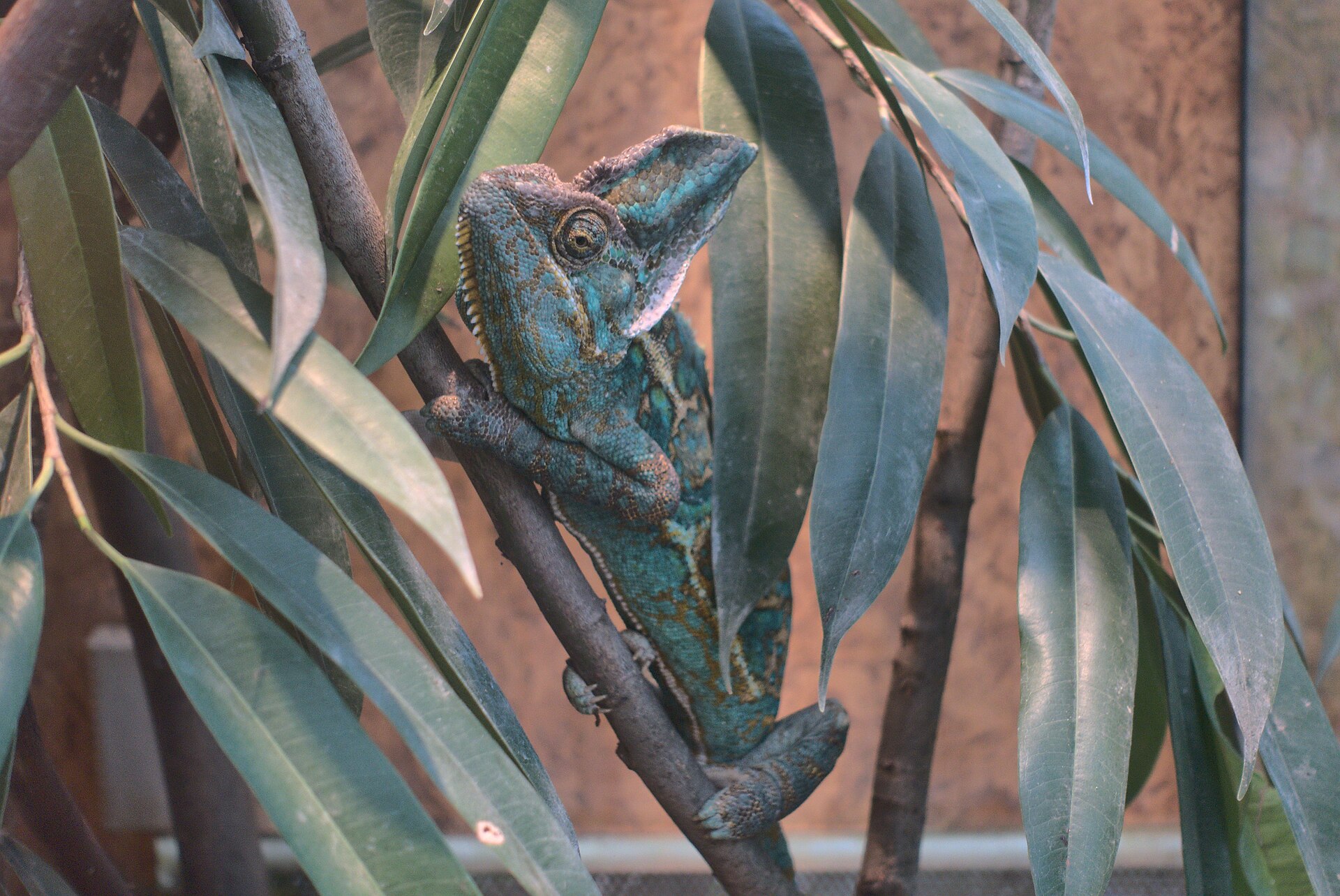
Chameleon Care
Chamaeleo calyptratus
A visually stunning but stress-sensitive arboreal chameleon requiring precise humidity cycling, daily misting, and a well-planted screen enclosure — not recommended for beginners.
UVB Setup Calculator
Enter your enclosure dimensions — we'll recommend the right UVB bulb and mounting height for Chameleon.
Chameleon care specs
- Care level
- advanced
- Adult size
- 18–24 in
- Lifespan (yrs)
- 6–8
- Basking (°F)
- 85–95
- Cool side (°F)
- 72–78
- UVB need
- high
- Target UVI (Ferguson)
- 3.0
- Humidity (%)
- 40–50 daytime
- Diet type
- insectivore
- Diet
- insectivore
- Min enclosure (adult)
- 2×2×4 ft
- Housing
- Strictly solitary
- Price (USD)
- 75–200
- Origin
- Highland valleys and mountain slopes of Yemen and southern Saudi Arabia
Where to buy & shop for Chameleon
Affiliate links — we may earn a small commission at no cost to you.
What is a Chameleon?
A Chameleon is a advanced-keeper lizard from valleys and mountain slopes of Yemen and southern Saudi Arabia. Adults reach 18–24 in (males larger; females 10–14 in) and can live 6–8 years in captivity — a long-term commitment. A visually stunning but stress-sensitive arboreal chameleon requiring precise humidity cycling, daily misting, and a well-planted screen enclosure — not recommended for beginners.
What size enclosure does a Chameleon need?
The minimum enclosure for an adult Chameleon is 2×2×4 ft (screen/mesh enclosure; height is critical — males need 4×2×4 ft minimum). Height is critical for this arboreal species — prioritise vertical space over floor footprint. A screen/mesh enclosure promotes the airflow this species needs to stay healthy.
What you need:
- Tall screen/mesh enclosure — height critical; prioritise vertical space over footprint.
- Live or artificial plants — for cover, perching, and humidity retention.
- Horizontal branches — multiple levels for basking and movement.
- Cross-ventilation — screen sides or cross-ventilation panels; stagnant humid air is fatal.
- Misting system — automated or manual, 2× daily minimum.
What temperature does a Chameleon need?
Provide a basking spot of 85–95°F and a cool side of 72–78°F. Measure AIR temperature at the basking branch, not surface. Use a high-wattage basking bulb on a dimmer or thermostat — never a heat rock. Drop to 55–65°F at night to support digestion and immune function.
| Zone | Temperature |
|---|---|
| Basking spot | 85–95°F (measure AIR temperature at the basking branch, not surface) |
| Cool side | 72–78°F |
| Night | 55–65°F |
Do Chameleons need UVB?
Yes — Chameleons need high UVB (target UVI 3.0). Use a T5 HO 6% tube (e.g., Arcadia Forest 6% or Zoo Med 5.0) mounted on top of the screen, positioned approximately ⅔ of the cage height from the basking branch. Do NOT use a 12–14% tube for screen-housed arboreal species — at close basking distances through screen it over-doses UVB. Verify with a Solarmeter 6.5 and replace bulbs every 12 months.
What humidity does a Chameleon need?
Maintain humidity at 40–50 daytime%. This species thrives on a wet/dry misting cycle — mist so all surfaces are wet, then allow the enclosure to dry fully before the next session. Good ventilation is non-negotiable; stagnant humid air causes fatal respiratory infections. A digital hygrometer is essential.
What do Chameleons eat?
Chameleons are insectivores — live or gut-loaded feeder insects are the diet staple. Primarily live insects: crickets, dubia roaches, hornworms, silkworms, black soldier fly larvae. Juveniles eat daily; adults 4–5 insects every other day. Veiled chameleons are unique in also accepting plant material — offer fresh leafy greens (collard, dandelion) as supplement, especially for females. All feeders must be gut-loaded and dusted with calcium (without D3 if UVB is adequate).
- Staple feeders — dubia roaches, crickets, or mealworms as the main protein source.
- Variety feeders — superworms, hornworms, black soldier fly larvae for enrichment.
- Gut-load first — feed insects a nutritious diet 24–48 hr before offering to your Chameleon.
- Calcium dusting — dust every feeding; use D3-containing supplement on a schedule matched to UVB.
- Fresh water — shallow dish changed daily; use a sponge or bottle cap to prevent drowning small feeders.
Can you house Chameleons together?
Strictly solitary — house individually. Chameleons cannot tolerate visual contact with conspecifics; cohabitation causes fatal chronic stress. Allow new animals at least 2 weeks to settle in before handling. Support the body fully — avoid grabbing from above, which triggers a defensive response.
Are Chameleons good for beginners?
Chameleons are an advanced species for experienced keepers. Research thoroughly, set up the enclosure fully, and source from a reputable captive-bred breeder before acquiring. Animals cost 75–200 (captive-bred juveniles); wild-caught not recommended.
What is a Chameleon?
A Chameleon is a advanced-keeper lizard from valleys and mountain slopes of Yemen and southern Saudi Arabia. Adults reach 18–24 in (males larger; females 10–14 in) and live 6–8 years in captivity.
How big do Chameleons get?
18–24 in (males larger; females 10–14 in). Chameleons reach this size over a lifespan of 6–8 years — plan your enclosure for the adult size from the start.
What size enclosure does a Chameleon need?
The minimum enclosure for an adult Chameleon is 2×2×4 ft (screen/mesh enclosure; height is critical — males need 4×2×4 ft minimum). Bigger is always better — provide the adult-size enclosure from day one rather than upgrading later.
What temperature does a Chameleon need?
Basking spot 85–95°F, cool side 72–78°F — measure with a digital thermometer. Night temperatures can drop to 55–65°F. Always measure with a reliable digital thermometer.
Do Chameleons need UVB?
High UVB need. Chameleons need high UVB. Target UVI: 3.0 at the basking branch. Use a T5 HO 6% tube (e.g., Arcadia Forest 6%) on top of the screen — NOT a 12–14% tube, which over-doses UVB at close range through screen. Verify with a Solarmeter 6.5.
What do Chameleons eat?
Primarily live insects: crickets, dubia roaches, hornworms, silkworms, black soldier fly larvae. Juveniles eat daily; adults 4–5 insects every other day. Veiled chameleons are unique in also accepting plant material — offer fresh leafy greens (collard, dandelion) as supplement, especially for females. All feeders must be gut-loaded and dusted with calcium (without D3 if UVB is adequate).
Can you house Chameleons together?
Strictly solitary — house individually. Chameleons cannot tolerate visual contact with conspecifics; cohabitation causes fatal chronic stress.
Are Chameleons good for beginners?
Advanced — Chameleons are not recommended for beginners. They require precise husbandry, are stress-sensitive, and do not forgive mistakes.
How long do Chameleons live?
6–8 years in captivity with proper care. This is a significant long-term commitment — factor that in before purchasing.
Sources
- https://www.zenhabitats.com/blogs/reptile-care-sheets-resources/veiled-chameleon-care-sheet-reptifiles
- https://reptifiles.com/veiled-chameleon-care-sheet/
- https://chameleonacademy.com/uvb/
- https://chameleonacademy.com/basics-uvb-for-chameleons/
- https://www.reptilecentre.com/blogs/reptile-blog/which-ferguson-zone-is-my-reptile-in