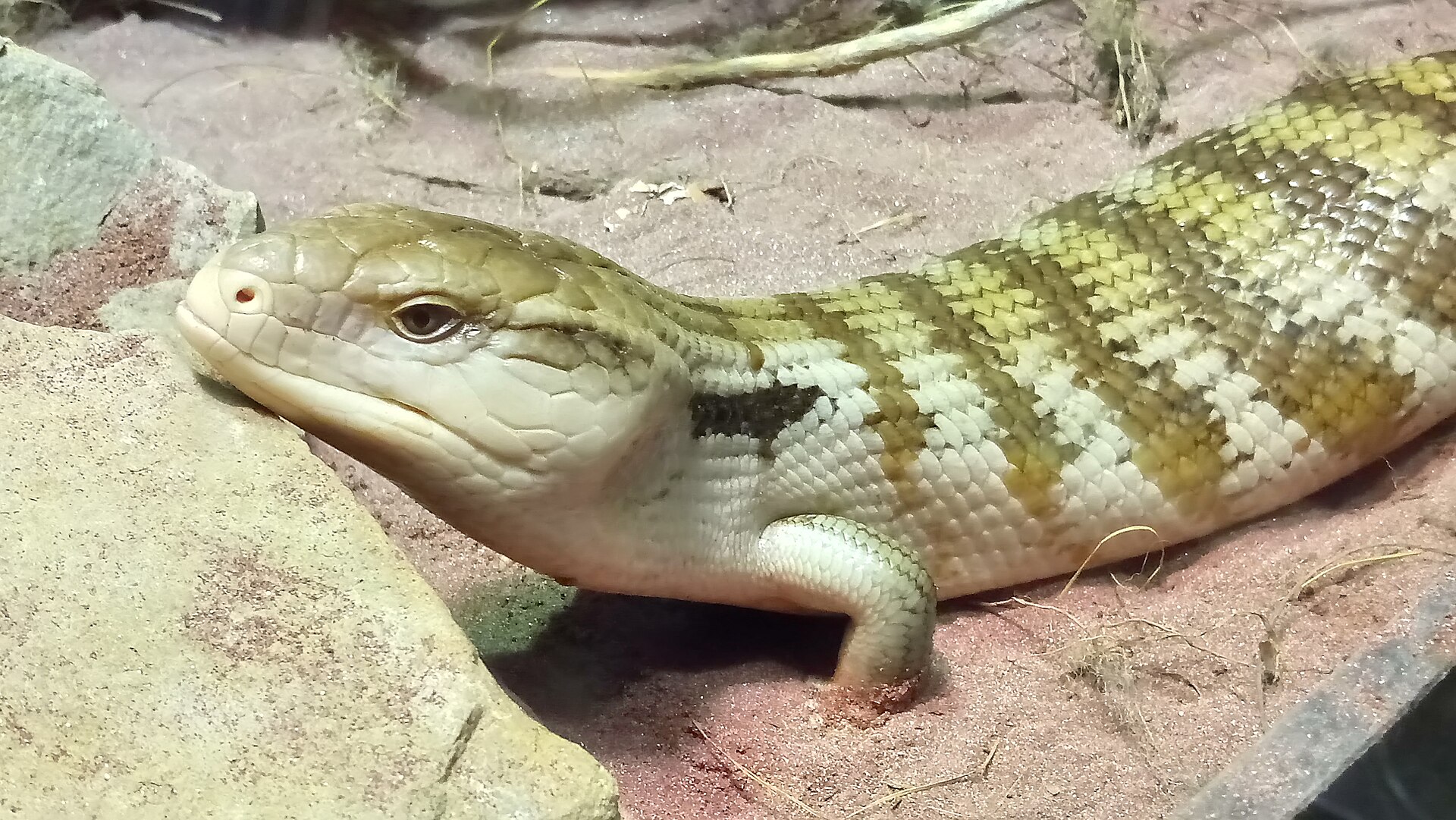
Blue-Tongue Skink Care
Tiliqua scincoides
A robust, dog-like omnivore from Australian grasslands with a famously docile temperament — an excellent step-up from beginner species that rewards its keeper with decades of companionship.
UVB Setup Calculator
Enter your enclosure dimensions — we'll recommend the right UVB bulb and mounting height for Blue-Tongue Skink.
Blue-Tongue Skink care specs
- Care level
- intermediate
- Adult size
- 18–24 in
- Lifespan (yrs)
- 15–20
- Basking (°F)
- 105–115
- Cool side (°F)
- 70–80
- UVB need
- moderate
- Target UVI (Ferguson)
- 3.0–4.0
- Humidity (%)
- 40–60
- Diet type
- omnivore
- Diet
- omnivore
- Min enclosure (adult)
- 4×2×2 ft
- Housing
- Solitary
- Price (USD)
- 150–250
- Origin
- Dry forests, open grasslands, shrublands, and rocky outcrops of northern and eastern Australia
Where to buy & shop for Blue-Tongue Skink
Affiliate links — we may earn a small commission at no cost to you.
What is a Blue-Tongue Skink?
A Blue-Tongue Skink is a intermediate-level lizard from Dry forests. Adults reach 18–24 in and can live 15–20 (reports of 30+ years with excellent care) years in captivity — a long-term commitment. A robust, dog-like omnivore from Australian grasslands with a famously docile temperament — an excellent step-up from beginner species that rewards its keeper with decades of companionship.
What size enclosure does a Blue-Tongue Skink need?
The minimum enclosure for an adult Blue-Tongue Skink is 4×2×2 ft (48×24×24 in; terrestrial — floor space priority over height). Bigger is always better — Blue-Tongue Skinks benefit from extra space to thermoregulate and express natural behaviours.
What you need:
- Secure, well-ventilated enclosure — screen top or side ventilation; tight-fitting lid.
- Thermostat-controlled basking lamp — dimmer or proportional thermostat; never a heat rock.
- Warm and cool hides — at least one hide on each end of the thermal gradient.
- Water bowl — shallow, heavy-bottomed; changed daily.
- Appropriate substrate — species-appropriate depth; moist hide in one corner.
What temperature does a Blue-Tongue Skink need?
Provide a basking spot of 105–115°F and a cool side of 70–80°F. Measure surface temperature with an infrared thermometer. Use a high-wattage basking bulb on a dimmer or thermostat — never a heat rock. Drop to 65–75°F at night to support digestion and immune function.
| Zone | Temperature |
|---|---|
| Basking spot | 105–115°F (measure surface temperature with an infrared thermometer) |
| Cool side | 70–80°F |
| Night | 65–75°F |
Do Blue-Tongue Skinks need UVB?
Blue-Tongue Skinks need moderate UVB — target UVI 3.0–4.0. Use a T5 HO 6% or 12% tube mounted at the correct distance above the basking spot. Use the UVB Calculator above — it accounts for enclosure height and basking platform height. Replace bulbs every 12 months.
What humidity does a Blue-Tongue Skink need?
Maintain humidity at 40–60%. Moderate humidity suits most commonly available substrates. Maintain a moist hide in one corner to support proper shedding. A digital hygrometer is essential.
What do Blue-Tongue Skinks eat?
Blue-Tongue Skinks are omnivores — diet composition changes significantly with age. Juveniles (0–8 mo): 70–80% protein, 20–30% plant matter; offered daily to 3× weekly. Adults (8+ mo): ~50% protein, 50% plant matter; offered 1–2× weekly. Protein sources: dubia roaches, crickets, earthworms, snails, canned dog/cat food (low sodium), ground turkey. Plant matter: dark leafy greens (collard, dandelion, endive), squash, bell peppers, snap peas. Avoid high-oxalate foods. Dust feeders with calcium+D3.
| Age | Diet | Frequency |
|---|---|---|
| Juvenile (6–12 mo) | 70–80% protein, 20–30% plant matter | 3× weekly |
| Adult (12+ mo) | ~50% protein, 50% plant matter | 1–2× weekly |
Can you house Blue-Tongue Skinks together?
Solitary — house individually. Territorial and will fight; bite wounds are severe. Allow new animals at least 2 weeks to settle in before handling. Support the body fully — avoid grabbing from above, which triggers a defensive response.
Are Blue-Tongue Skinks good for beginners?
Blue-Tongue Skinks are intermediate-level — not ideal for complete beginners. Suitable for keepers who have successfully maintained a beginner reptile for at least a year. Animals typically cost 150–250 (captive-bred Northern/Eastern T. scincoides); rare morphs (ivory, piebald) 1,000–5,000+. Budget for quality enclosure hardware — this species will show you quickly if something is wrong.
What is a Blue-Tongue Skink?
A Blue-Tongue Skink is a intermediate-level lizard from Dry forests. Adults reach 18–24 in and live 15–20 (reports of 30+ years with excellent care) years in captivity.
How big do Blue-Tongue Skinks get?
18–24 in. Blue-Tongue Skinks reach this size over a lifespan of 15–20 (reports of 30+ years with excellent care) years — plan your enclosure for the adult size from the start.
What size enclosure does a Blue-Tongue Skink need?
The minimum enclosure for an adult Blue-Tongue Skink is 4×2×2 ft (48×24×24 in; terrestrial — floor space priority over height). Bigger is always better — provide the adult-size enclosure from day one rather than upgrading later.
What temperature does a Blue-Tongue Skink need?
Basking spot 105–115°F, cool side 70–80°F — measure with a digital thermometer. Night temperatures can drop to 65–75°F. Always measure with a reliable digital thermometer.
Do Blue-Tongue Skinks need UVB?
Moderate UVB need. Blue-Tongue Skinks need a moderate-output UVB tube. Target UVI: 3.0–4.0 at the basking spot. Use the UVB Calculator on this page to find the right setup.
What do Blue-Tongue Skinks eat?
Juveniles (0–8 mo): 70–80% protein, 20–30% plant matter; offered daily to 3× weekly. Adults (8+ mo): ~50% protein, 50% plant matter; offered 1–2× weekly. Protein sources: dubia roaches, crickets, earthworms, snails, canned dog/cat food (low sodium), ground turkey. Plant matter: dark leafy greens (collard, dandelion, endive), squash, bell peppers, snap peas. Avoid high-oxalate foods. Dust feeders with calcium+D3.
Can you house Blue-Tongue Skinks together?
Solitary — house individually. Territorial and will fight; bite wounds are severe.
Are Blue-Tongue Skinks good for beginners?
Intermediate — Blue-Tongue Skinks need a keeper who has already successfully maintained a simpler reptile. Not ideal as a first reptile.
How long do Blue-Tongue Skinks live?
15–20 (reports of 30+ years with excellent care) years in captivity with proper care. This is a significant long-term commitment — factor that in before purchasing.
Sources
- https://reptifiles.com/blue-tongue-skink-care/blue-tongue-skink-temperature-humidity-light/
- https://www.thebiodude.com/blogs/lizard-caresheets/care-and-maintenence-of-the-northern-blue-tongue-skink
- https://dubiaroaches.com/blogs/lizard-care/blue-tongue-skink-care-sheet
- https://www.birdexoticsvet.com/blue-tongued-skink-care-guide
- https://www.reptilecentre.com/blogs/reptile-blog/which-ferguson-zone-is-my-reptile-in